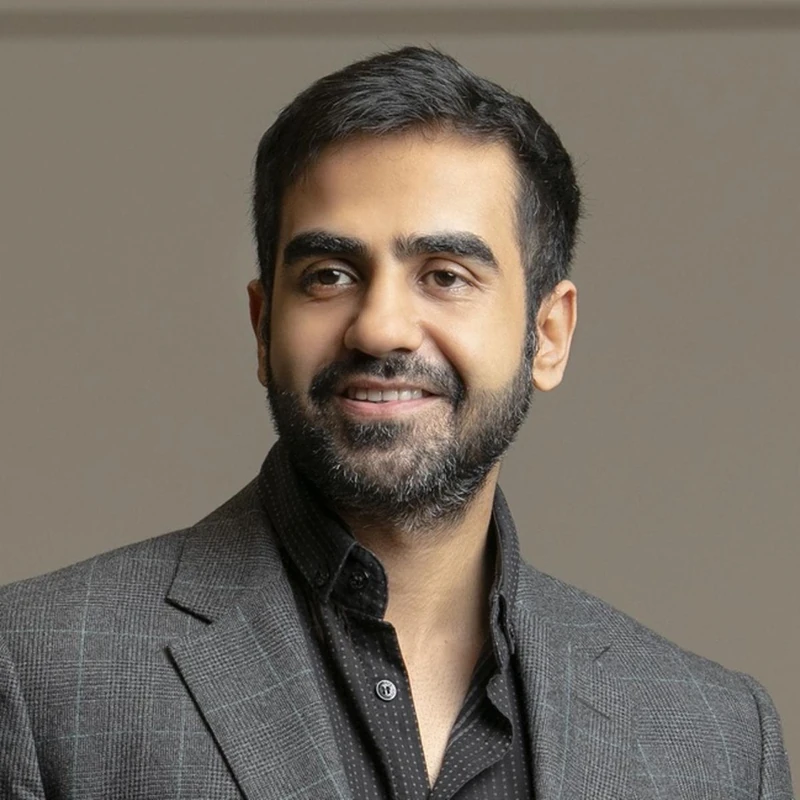

Healthcare executives entered 2026 with a seductive productivity proposition. Generative systems can listen to consultations, draft notes, summarise hospital stays and search records. If they reduce documentation, clinicians can see more patients and burn out less. Abraham Verghese's work at Stanford complicates that investment case in a useful way. Time saved has value only if it returns the clinician's attention to the patient rather than becoming another unit of throughput.
Verghese is professor emeritus of medicine and continues to direct Presence, the Stanford programme he founded to study and strengthen human connection in care. He has argued for years that technology should support the bedside encounter rather than displace it. That position once sounded like a humanistic correction to electronic records. As hospitals sign contracts for ambient artificial intelligence, it has become an operating and capital-allocation framework.
The question is no longer whether machines belong in the consultation. They already do. The decision facing health systems is which tasks to automate, how much verification to retain and where the released capacity should go. Verghese's contribution is to insist that presence is not decorative. Attention can reveal a missed physical sign, improve trust, elicit a crucial history and reduce error. An AI programme that creates shorter notes but a more distracted clinician has failed economically as well as clinically.
Early evidence is promising and inconvenient
A Stanford pilot published in 2026 shows why simple return-on-investment claims are premature. An AI workflow drafted hospital-course summaries for 384 discharges, generating 1,274 summaries. Physicians used AI content in 57 per cent of cases. Among the summaries that received detailed feedback, omissions were identified in 25 per cent, inaccuracies in 20 per cent and hallucinations in 2 per cent. No severe harm was reported, and independent review found the system broadly safe in that controlled setting.
The tool was associated with a significant decline in physician burnout scores, an important result for hospitals facing retention pressure. Measured documentation savings were modest and statistically uncertain, reaching no more than about three minutes for matched users, even though clinicians felt that they had saved much more. Revising a draft may be cognitively easier than composing one from scratch. That benefit is real, but it does not automatically translate into more billable appointments.
This distinction matters to buyers. Vendors often sell AI through labour efficiency, while staff may value it through reduced exhaustion. A health system should model both. Lower burnout can reduce turnover, recruitment costs and clinical risk over time, but the effect is harder to book in a quarterly budget. Forcing every saved minute into additional patient volume may recreate the burden the software was intended to relieve.
Other early data reinforce the need for caution. In a Stanford emergency-department study, ambient scribes were used in only 11.2 per cent of eligible encounters. Adoption was concentrated among a minority of doctors and in lower-acuity, non-interpreted cases. Documentation time was shorter when the tool was used, but the pattern suggests that the easiest encounters receive the technology first. A system that works mainly for straightforward English-language care may widen productivity and access gaps.
Presence is an operating capability
Presence has tried to define the clinical encounter as a purposeful practice of awareness, focus and connection. Its Presence 5 framework turns that principle into behaviours that can be taught and studied. This is important for management because values that remain abstract rarely survive budget pressure. A hospital can train clinicians to prepare before entering, listen actively, agree on priorities and close the encounter clearly, then examine whether those practices affect experience and safety.
Verghese also directs attention to the physical examination. Digital records contain vast amounts of data, yet a copied diagnosis or an omitted bedside finding can propagate through the system. Automation may summarise that record more elegantly without correcting the underlying mistake. The body remains an independent source of information. When AI takes over clerical work, the released attention should strengthen observation and conversation rather than encourage clinicians to accept the record as complete.
The commercial implications extend beyond ambient scribes. Clinical decision support, remote monitoring and automated triage all change where attention is allocated. A tool can prioritise a patient for review, but management must decide who responds and how quickly. Without redesigned workflow, alerts become another queue. Technology investment should therefore include training, escalation protocols, quality monitoring and protected time for staff to act on the output.
That makes implementation more expensive than a software licence. Hospitals need secure data infrastructure, integration with electronic records, consent processes and human review. They also need a method for measuring omissions, bias and near misses after deployment. The cheapest pilot can become costly at scale if clinicians create parallel workarounds or if poor notes generate downstream corrections.
The financial return sits across the system
Healthcare leaders often seek a single savings line to justify AI. The more credible value case is distributed. Better documentation may support accurate coding and reduce claim denials. Less after-hours clerical work may improve retention. Clearer discharge summaries may reduce follow-up confusion. More attentive visits may increase adherence and uncover conditions earlier. Patient trust may strengthen a health system's reputation and referral base.
Distributed value is difficult to attribute, which creates a procurement risk. A department that pays for software may not receive the savings generated elsewhere. Finance teams should establish enterprise measures before implementation: total record time, staff turnover, note quality, denial rates, adverse events, patient experience and appointment capacity. Vendors should be paid against outcomes they can influence, not simply seats activated or notes produced.
Human review is another hidden cost. Clinicians remain responsible for machine-drafted content and must verify it. As models produce more polished text, automation bias may make errors harder to notice. The Stanford discharge pilot found omissions more often than hallucinations, a useful warning. Missing context can be clinically important even when every sentence present is accurate. Quality assurance should test completeness, not just false statements.
There is also a liability allocation problem. Contracts may limit vendor responsibility while the hospital and clinician carry clinical risk. Regulators are still adapting. Health systems should retain audit trails showing the source, edit history and final approval of machine-generated notes. That infrastructure does not create revenue, but it protects the organisation when an error is questioned.
Asia makes the attention problem larger
The World Health Organization's South-East Asia region covers nearly two billion people and faces workforce shortages, geographic remoteness and a growing burden of chronic disease. Digital health can extend scarce expertise, standardise information and support clinicians working under extreme volume. The region is also home to ambitious national digital programmes, making it a natural scale market for clinical AI.
Verghese's framework is especially relevant where consultation time is already compressed. Automation could give a doctor minutes to examine and explain; it could also be used to increase the daily queue. The latter may improve apparent access while reducing diagnostic attention. Policymakers and hospital groups should treat time returned to care as an explicit benefit, not unallocated capacity available for immediate extraction.
Language and culture raise additional barriers. Asia's consultations frequently move between languages or combine them. Patients may use local expressions for symptoms that generic models misunderstand. The emergency-department adoption pattern in non-interpreted cases suggests that performance advantages can bypass those with the greatest communication needs. Local validation must include accents, code-switching, low health literacy and interpreter-mediated encounters.
Data infrastructure is uneven as well. Large urban hospital groups may have integrated records; rural clinics may rely on paper or fragmented systems. Generative tools trained on well-documented tertiary care can perform poorly when context is sparse. Investment should not divert funds from nursing, primary care or interoperable records that make AI useful. Technology can multiply workforce capacity, but it cannot substitute for a workforce that does not exist.
A leadership standard for the AI clinic
Verghese does not lead a listed healthcare company, yet his influence bears directly on how billions in health-technology capital are deployed. Presence reframes the buyer's objective. The goal is not maximum automation; it is a safer and more humane allocation of scarce clinical attention. That changes product design, workflow and the definition of productivity.
Health systems should begin with tasks clinicians regard as burdensome and that can be verified reliably. Documentation is a logical target because the physician sees the final note. Autonomous diagnostic or triage functions require a higher evidence threshold. Deployment should advance by patient complexity and language only when performance is demonstrated, with no assumption that success in an academic English-language clinic transfers directly to an Asian public hospital.
Boards also need to ask what happens to the released time. If it becomes more patient contact, rest or team discussion, the return may appear through retention and safety. If it is absorbed by new administrative work, the investment has merely moved the burden. If it is converted into volume, management should monitor whether visit quality or outcomes deteriorate. None of these choices is neutral.
The decisive 2026 proof will not be a model benchmark or a large deployment contract. It will be evidence that clinicians spend less time serving the record, patients receive more reliable attention and error does not shift into a less visible form. Verghese has spent years establishing presence as part of medicine's technical core. AI will justify its healthcare valuation when it makes that scarce human capability more available, including to the patients and languages that are hardest to serve.