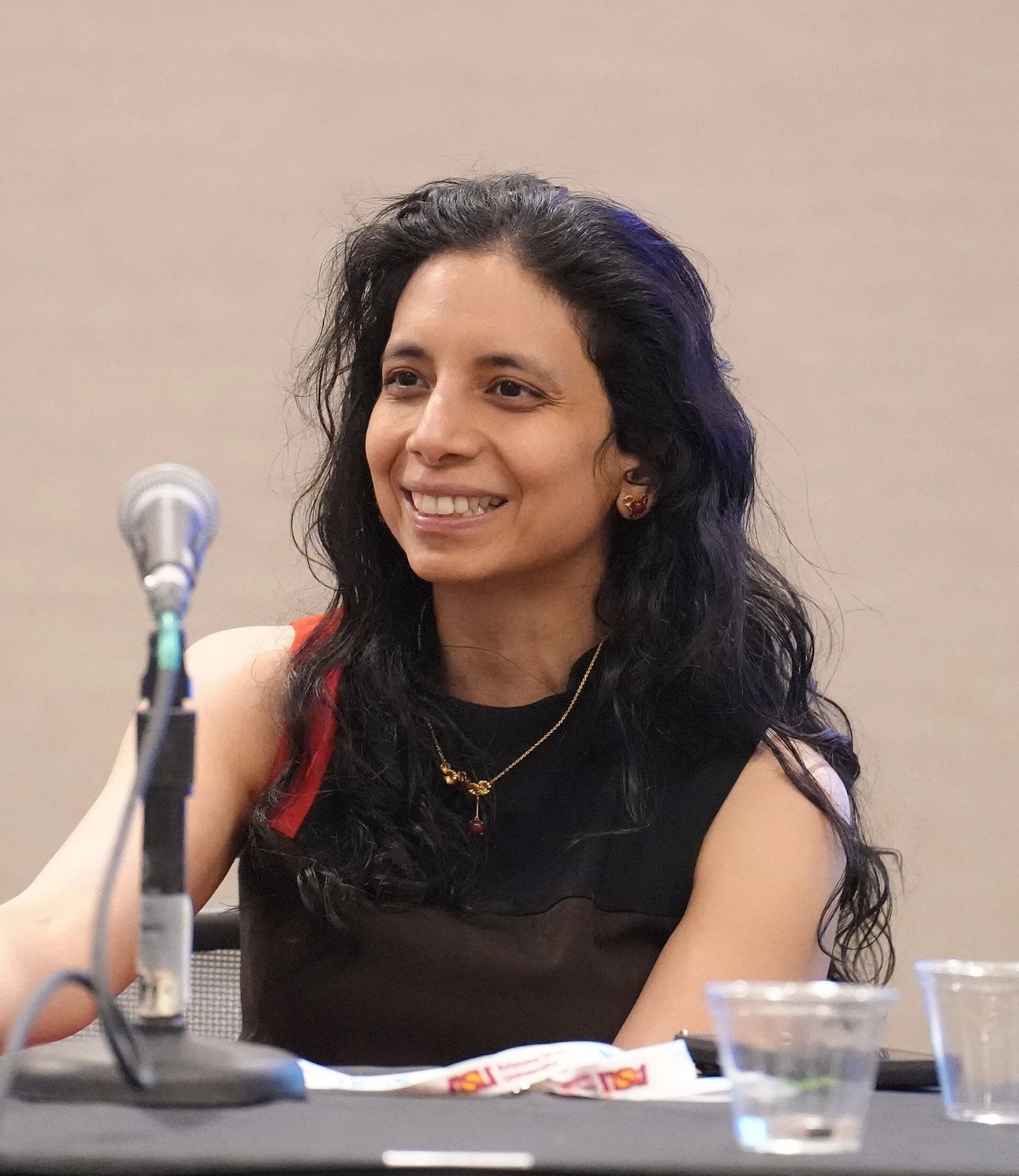
Anima Anandkumar entered a different arena in March 2026. The Bren Professor of Computing and Mathematical Sciences at the California Institute of Technology joined the United Nations Secretary-General’s Scientific Advisory Board, placing a specialist in large-scale artificial intelligence and scientific computing inside a body designed to advise senior UN leaders. Her task is no longer confined to making algorithms perform. It includes helping institutions decide which machine-assisted scientific claims deserve trust, investment and public authority.
The appointment arrived as AI moved deeper into laboratories, defence research, drug discovery and mathematical reasoning. In those settings, a fluent answer has little value unless another researcher can check the chain of evidence. The cost of error can include a failed experiment, a misdirected grant or an unsafe engineered system. Anandkumar’s work in formal methods offers one response: connect statistical systems to mathematical environments that can verify whether each step follows defined rules.
Verification alone is not a global policy. Advanced scientific AI depends on scarce processors, specialist engineers, curated data and dependable electricity. Universities and companies with the largest budgets can test more hypotheses, reproduce more results and attract more talent. Institutions without that capacity may become customers for discoveries made elsewhere. Anandkumar’s leadership test is to link rigour with access, so that stronger standards do not become another financial barrier to participation.
Formal proof changes what a machine can claim
In April 2026, Anandkumar and Caltech mathematician Sergei Gukov received support through a US defence research programme focused on AI and mathematics. Their collaboration addresses the Andrew-Curtis conjecture, an unsolved problem in group theory. The researchers formalised the conjecture in Lean, a proof-assistant environment, and used large AI systems to help search for mathematical advances.
The project builds on a sequence of tools from Anandkumar’s group. LeanDojo, introduced in 2023, created an open framework connecting automated reasoning with Lean. LeanAgent extended that work with a system intended to accumulate mathematical knowledge over time. TorchLean applies formal verification to neural systems, including controllers and physics-informed networks. Together, the projects move evaluation away from whether an output looks convincing and towards whether it satisfies a machine-checkable specification.
That distinction has commercial consequences. A pharmaceutical company screening molecules, an aerospace supplier validating a controller and a bank testing a risk model face different regulation, yet all need evidence that a system behaved within stated limits. Formal methods can reduce the amount of trust placed in presentation quality. They can also create an audit record for insurers, regulators and customers deciding who bears responsibility when an automated system fails.
A proof assistant does not make every scientific conclusion true. It can verify that a derivation follows from encoded assumptions, but the assumptions may describe the wrong phenomenon or omit a material condition. A perfectly checked theorem can be irrelevant to the physical system a company intends to operate. Data can still be biased, measurements noisy and objectives poorly chosen. Verification therefore adds a layer of assurance; it does not remove the need for experiments, domain expertise or independent replication.
The economic question is where that layer creates enough value to justify its cost. Formalising a problem requires skilled labour, and proof search consumes computing resources. High-consequence uses can support the expense because a prevented failure is valuable. Exploratory science may need lighter controls. Anandkumar can help define a tiered approach in which assurance rises with the stakes, rather than imposing the same burden on a classroom calculation and a safety-critical system.
The UN inherits a verification problem
The Secretary-General’s Scientific Advisory Board sits between research and institutional decision-making. Its mandate covers science, technology, ethics, governance and sustainable development, supported by a network intended to include varied disciplines and regions. Anandkumar joined as one of the eminent scientific members, alongside chief scientists and science leaders from the UN system. The position gives her access to policy conversations, not executive control over member states or technology companies.
The board’s 2026 horizon-scanning exercise drew on 192 scientists and technologists across 11 affiliated networks. It identified a shift from isolated tools towards AI as system-level infrastructure, with governance gaps, unequal access and weak institutional capacity among the dominant risks. That framing is commercially important. Once governments and laboratories build procurement, research workflows and public services around AI, changing a flawed system becomes expensive.
Anandkumar also inherits an agenda developed before her appointment. The board has examined verification of frontier AI and warned that software, hardware, audits and computing records may all be needed to test claims. A March 2026 brief on deceptive behaviour argued that detection tools are incomplete and called for shared evaluation standards and international cooperation. Her contribution should connect those broad concerns to the discipline of formal reasoning without implying that mathematical proof can audit every social or political effect.
Practical standards need several layers. Developers should disclose the system version, evaluation conditions and material limitations. Scientific users should record data provenance, computational settings and unsuccessful replications. Independent assessors need secure access to test consequential claims. Procurement contracts should specify incident reporting, model changes and the customer’s right to examine evidence. Each requirement has a cost, but ambiguity usually transfers a larger cost to users after failure.
Common standards can expand markets by reducing duplicated diligence. A hospital, manufacturer or public laboratory is more likely to buy a scientific AI service if its evidence package is recognised across jurisdictions. Poorly designed standards can entrench incumbents, because only the largest vendors can afford complex certification. The UN’s value lies in defining outcomes and interoperable evidence rather than prescribing one expensive technical stack.
No global benchmark can settle every context. A reasoning system trained on formal mathematics does not establish clinical validity, and an English-centred evaluation may miss failures in other languages. Standards should distinguish universal properties, such as traceability and change control, from domain tests set by relevant scientific and regulatory communities. Anandkumar’s technical credibility can help resist the urge to compress that distinction into a single score.
Compute access is a governance decision
Scientific computing has always been capital intensive, but AI has widened the gap between institutions. Leading systems require advanced chips, high-speed networks, storage and engineering support. Cloud access converts part of the fixed cost into operating expense, yet sustained experimentation remains expensive. The laboratories able to run many trials gain information faster, publish sooner and improve their systems through use.
Equity cannot mean distributing temporary computing credits while leaving institutions dependent on a distant provider. Durable access requires regional infrastructure, technical training, reliable data governance and budgets for maintenance. Shared facilities can improve utilisation, while pooled purchasing can give universities and public laboratories more bargaining power. Open evaluation suites reduce duplicated work. These mechanisms are less visible than a new model release, but they determine who can conduct science rather than merely consume it.
Asia contains both globally competitive computing centres and institutions operating with severe constraints. Anandkumar studied engineering at the Indian Institute of Technology Madras before building her academic career in the United States, giving her a professional connection to a region where research capacity varies sharply. India, Southeast Asia and the Pacific cannot be treated as one market. Electricity cost, cloud availability, public funding and access to specialist talent differ within countries as well as between them.
Compute policy also shapes corporate power. When a laboratory builds its workflows around one cloud platform or accelerator, moving data and software can become costly. Vendors can subsidise initial research access and recover value through long-term dependence. Public funders should require portability, transparent usage accounting and exportable records. Interoperability is a competition policy as much as a technical preference.
Open software helps, but it does not erase the hardware divide. LeanDojo and related frameworks allow researchers to inspect methods and build on prior work. They still require machines, formalised corpora and people able to operate the tools. A serious access programme would measure completed research, local expertise and reproducibility, not the number of accounts or credits distributed.
Scientific markets need evidence that survives
AI-assisted science is attracting capital because it promises to shorten discovery cycles. The financial case weakens when results cannot be reproduced outside the developer’s environment. A faster route to an unreliable conclusion simply moves cost downstream, where failed validation, regulatory delay and abandoned development can be far more expensive. Verification should therefore be evaluated as research infrastructure, alongside laboratory quality systems and data management.
Investors and grant committees need reporting that separates search productivity from scientific validity. Useful measures include the proportion of machine-proposed results that pass formal checks, the rate of independent replication, the computing cost per validated result and the performance of a method on unseen problems. Reporting only the volume of generated hypotheses rewards activity rather than knowledge.
Benchmark contamination is another capital risk. A system may appear to solve a problem because related material was present in its training data or because repeated evaluation shaped development towards the test. Prospective challenges, sealed test sets and time-stamped records can provide stronger evidence. Formal proof can confirm a result’s internal logic, while provenance controls help establish that the result was genuinely produced under the claimed conditions.
Defence-funded mathematics exposes the tension between openness and security. Some methods benefit from public scrutiny; other details may be restricted because they affect national capability. Commercial partners also protect intellectual property. Standards should allow confidential inspection by trusted assessors while publishing enough information for the wider community to understand limitations. Total secrecy prevents accountability, while indiscriminate disclosure can undermine legitimate safeguards.
Verification can itself become a competitive moat. Large vendors may build proprietary testing suites and ask customers to accept their internal assurance. Independent tools and common evidence formats provide an alternative. They let smaller companies demonstrate quality without recreating an entire compliance regime, and they allow buyers to compare systems on more than brand and computing scale.
Influence without executive authority
Anandkumar cannot direct national research budgets or compel a vendor to submit to testing. The advisory board’s influence depends on the usefulness of its analysis, the coalitions it builds and the willingness of UN institutions to incorporate recommendations into procurement and development programmes. That makes specificity essential. General calls for responsible and inclusive science are easier to endorse than to fund.
Concrete deliverables could include minimum evidence requirements for high-consequence scientific AI, a map of regional computing capacity, templates for independent replication and principles for public purchasing. The board could also encourage pooled facilities that serve researchers across borders and multilingual evaluation programmes led by local institutions. Those steps would connect governance language to capital allocation.
Independence must remain visible. Anandkumar was a senior director of AI research at Nvidia until 2023 and is now a Caltech professor. Her industrial experience helps her understand how advanced systems are built, while her present academic position gives her room to challenge vendor claims. Clear disclosure of collaborations, funding and technical dependencies will strengthen the authority of any standards she helps shape.
The strongest outcome would not be a universal seal of approval for machine-assisted science. It would be a market in which evidence travels: a result can be checked across tools, institutions and borders, and researchers can participate without accepting permanent dependence on one provider. Anandkumar’s mathematics work shows how claims can be made inspectable. Her UN role will be judged by whether that discipline reaches policy while scientific capacity reaches beyond the institutions already able to buy it.