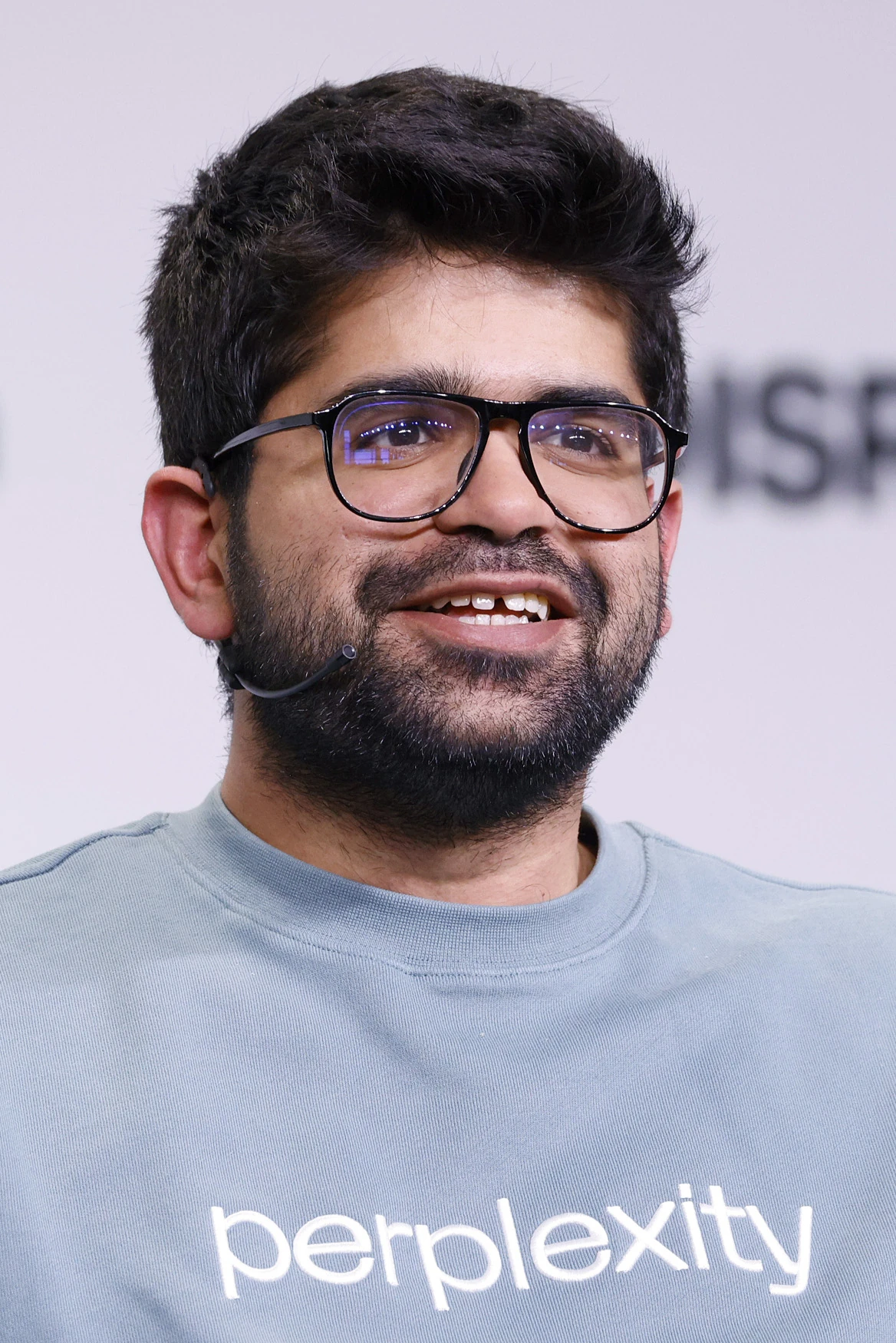
Aravind Srinivas has spent 2026 expanding Perplexity's definition of itself. The company began with an answer engine that searched the web and returned concise responses with inline citations. It now presents a much wider product surface: Comet as an AI-native browser, Computer as a multimodel agentic workspace, Personal Computer across local files and applications, specialised products for finance, health, tax and legal work, enterprise deployments, and developer services covering search, agents and isolated code execution. Perplexity says it answers more than 1.5 billion questions a month. The strategic ambition has shifted from improving search to becoming a layer through which people research, decide and complete work.
Srinivas remains co-founder and chief executive, and his product instincts have made Perplexity one of the most visible challengers created by the generative-AI cycle. Speed has been an advantage. The company has turned model advances into usable interfaces quickly, maintained a model-agnostic position and made citations a familiar part of AI answers. Yet the very pace that established Perplexity now creates its next leadership problem. Every new product adds distribution potential, engineering cost, support requirements and strategic ambiguity. Srinivas must prove that this widening portfolio is one coherent system with durable economics, rather than a series of impressive responses to whatever frontier models make possible next.
The answer engine created a clear wedge
Perplexity's original proposition was easy to understand. Traditional search returned links; conversational models returned fluent but sometimes unsupported text. Perplexity combined retrieval, synthesis and visible sourcing. That design reduced the work required to begin research and gave users a way to inspect the basis of an answer. It did not solve accuracy completely, but it created a useful product category between a search box and a general chatbot.
The wedge also gave Srinivas a distinctive market position. Perplexity did not need to train the largest foundation model. It could route questions across models, invest in retrieval and build the interaction layer. That allowed a relatively young company to benefit from advances made by several model providers. It also introduced dependency. Model access, latency and price sit partly outside Perplexity's control, while larger providers can add search and citation features to their own products.
The answer is to build value above model selection. Proprietary ranking, query planning, source quality, workflow memory and user context can make the system better even when underlying models become widely available. Srinivas should keep the product's original clarity as a benchmark. A user understood why the answer engine existed. Every new surface should be able to explain its distinctive job as simply.
Computer is a bet on orchestration
Perplexity Computer, introduced in February, is based on the idea that no single model family is best at every task. The product orchestrates different models across research, files, tools, code and the open web. Instead of asking a user to choose a model and manage a sequence of prompts, Computer is intended to decompose work, select capabilities and carry a task towards a finished output. In June, the company added deeper research, memory and specialised professional versions. It has also connected the system to common workplace applications.
This is a meaningful strategic distinction. Model companies tend to optimise their own families, while software suites prioritise their installed ecosystems. Perplexity can position itself as a neutral control layer that chooses the best tool for the job. If model performance continues to leapfrog, neutrality becomes more valuable. Enterprises may prefer a system that can switch providers rather than bind workflows to one vendor.
Orchestration is not free. Each task can invoke multiple expensive models, searches and tool calls. Long-running agents create variable computing costs and unpredictable completion time. Srinivas needs an economic architecture as sophisticated as the technical one. Routing must consider cost and latency alongside quality. The product should reserve premium models for steps where they change the outcome, use smaller models for routine work and stop tasks that are unlikely to succeed. A compelling demonstration can consume resources generously; a scalable service must know the marginal cost of each completed job.
Vertical products can sharpen or scatter the strategy
Perplexity has moved quickly into professional domains. Computer for finance, taxes, counsel, health and growing businesses reflects the insight that generic intelligence becomes valuable when paired with authoritative sources, domain tools and repeatable workflows. Finance users need filings, market data and auditable calculations. Legal users need jurisdiction, source hierarchy and careful handling of confidential documents. Health users require premium information and clear boundaries around decision support. A general chat interface cannot meet those needs through language alone.
Verticalisation can improve willingness to pay and provide stronger product feedback. A professional user can quantify time saved and may adopt a tool through an enterprise budget. Domain data partnerships can create differentiation that general models cannot easily copy. Perplexity can reuse its retrieval, orchestration and citation infrastructure while adapting workflows and assurance.
The danger is building a separate company for every profession. Each vertical introduces sales expertise, compliance, source licensing and customer support. Srinivas must choose where Perplexity's core assets create an unfair advantage. The standard should be more demanding than whether Computer can perform a task. The company should ask whether it can deliver the task reliably, acquire users efficiently, charge enough to cover model and data costs, and improve through repeated use. Products that do not meet those conditions should remain templates or partnerships rather than become full business lines.
Developer infrastructure changes the customer
Perplexity's Search API, Agent API and Sandbox API extend the company from an end-user destination into infrastructure used by other applications. This route can diversify distribution and monetise capabilities that Perplexity already needs internally. Developers can use current web extraction, managed agent execution and isolated code environments without rebuilding the stack. The APIs also create a way for Perplexity to reach users who may never visit its consumer interface.
Infrastructure customers have different expectations. They require stable interfaces, predictable pricing, observability, service guarantees and documentation. They need to understand how sources are selected, how failures are surfaced and how data is handled. Product changes that delight consumer users can break developer applications. Srinivas must separate experimentation from contractual reliability.
The economics can be attractive if shared infrastructure operates at scale, but competition is intense. Model providers, cloud platforms and search specialists all offer adjacent capabilities. Perplexity's differentiation should come from the quality of its retrieval and orchestration, not from packaging alone. The company needs clear performance benchmarks that reflect dynamic web tasks rather than static demonstrations. Developer retention and workload growth will be better evidence of advantage than sign-up numbers.
Distribution is becoming a portfolio decision
Perplexity is pursuing several distribution paths simultaneously. The consumer answer engine creates direct habit. Comet owns the browsing surface. Personal Computer brings agents to local files and applications. Enterprise products enter through information-technology teams. APIs enter through developers. Device partnerships can place Perplexity capabilities in front of large mobile audiences. Each path can increase reach, but each competes for product attention and marketing investment.
Srinivas should define the role of every surface. The answer engine can remain the top-of-funnel product for curiosity and research. Computer can monetise complex work. Enterprise can add security, administration and collaboration. APIs can turn internal capabilities into a platform. The browser and device channels can reduce reliance on users deliberately visiting a website. If those roles are explicit, the portfolio reinforces itself. If every product tries to become the primary interface, teams will duplicate features and users will struggle to understand where work should begin.
Account architecture matters. Memory, preferences, source libraries and billing should travel coherently across products while users retain control. An answer started on a phone might become a longer Computer task at a desk. An enterprise administrator needs policies that apply across surfaces. Product integration should make the portfolio feel smaller even as capability expands.
Model neutrality needs commercial leverage
Perplexity's multimodel approach protects it from depending entirely on one technical frontier, but it can also place the company between powerful suppliers. Model providers may compete with Perplexity at the application layer while charging it for inference. Distribution partners may seek favourable economics. Premium data owners can raise licensing costs. As usage grows, gross margin depends on negotiating and engineering across all three.
Srinivas must build leverage through volume, differentiated demand and technical efficiency. Smart routing can reduce unnecessary calls. Caching and retrieval can answer repeated information needs without invoking the most costly reasoning. Contracts should preserve the ability to switch providers. Perplexity can also develop selective in-house models where they materially improve ranking, retrieval or cost, without attempting to reproduce every frontier capability.
Pricing should reflect work completed, but remain understandable. Flat consumer subscriptions can support habitual research, while high-compute agent tasks may require usage tiers. Enterprise contracts can price administration, security and premium sources. APIs need transparent metering. The company should avoid using venture capital to conceal unit economics indefinitely. Product velocity creates strategic value only if greater use produces a believable route to gross profit.
Accuracy becomes operational quality
As Perplexity moves from answers to actions, accuracy changes meaning. A research response can be inspected and corrected before use. An agent that edits a file, sends a message or completes a workflow can create consequences directly. Quality therefore includes tool selection, permission, state management, recovery and clear hand-off to the user. An apparently correct final output may still be unacceptable if the process exposed confidential data or changed the wrong resource.
Perplexity has invested in research on accuracy, agent memory and browser security. Srinivas needs to turn that work into product gates. Complex workflows should expose plans, checkpoints and provenance. High-impact actions should require confirmation. Evaluation should cover end-to-end task completion rather than isolated model answers. Failures need categorisation so that routing, tools and instructions improve systematically.
This discipline supports product economics as well as safety. Failed tasks waste inference and support cost. Overly cautious agents frustrate users. The company needs to find the point at which autonomy saves meaningful work without creating unacceptable error. That balance will differ by vertical. A finance analysis, legal draft and travel booking should not share identical permissions simply because they use the same orchestrator.
Management bandwidth is now the scarce resource
The pace of Perplexity's 2026 releases is striking. In a few months the company announced Computer, enterprise variants, local-computing products, professional workflows, developer services, memory research and multiple integrations. Rapid shipping is culturally valuable in a changing market. It can also prevent teams from deepening products, improving reliability and learning from actual use.
Srinivas should establish a portfolio review that is as rigorous as model evaluation. Each initiative needs a target user, economic thesis, adoption measure, reliability threshold and owner. Some experiments should graduate; many should stop. Shared components should be funded centrally, while vertical teams prove demand before expanding. The chief executive's attention should concentrate on platform architecture, distribution choices, major supplier relationships and leadership recruitment rather than every launch detail.
Organisational depth will determine whether Perplexity can mature. Consumer, enterprise, developer and regulated-domain products require different leaders. Senior executives need authority to decline features and protect reliability. A founder's instinct can identify a product opportunity, but a durable portfolio requires systems that allocate engineers and compute after the excitement of launch has faded.
Focus is the next product
Perplexity's next scorecard should look beyond question volume and release cadence. Computer needs evidence of repeated, completed work and acceptable unit cost. Professional products need paid retention and domain reliability. APIs need stable workloads and developer loyalty. Distribution partnerships need to create active users rather than installed presence. The answer engine must retain its clarity while feeding the wider platform. Across all products, gross margin should improve as routing and scale become more efficient.
Srinivas has already demonstrated that a start-up can reshape user expectations around search. He has also made a credible argument that the next interface will orchestrate models and tools rather than rely on a single intelligence. The unresolved question is how many products Perplexity must own to deliver that future. Owning every surface may create reach, but it can also dilute differentiation and increase dependence on external models and data.
The most important leadership move in 2026 is therefore not another launch. It is a coherent hierarchy. Perplexity should know which product creates habit, which completes valuable work, which supplies infrastructure and which experiments deserve only limited capital. If Srinivas can impose that focus without slowing necessary invention, the company may develop from a celebrated answer engine into a durable software platform. If not, rapid expansion will make the business harder to understand faster than it makes it harder to copy.