
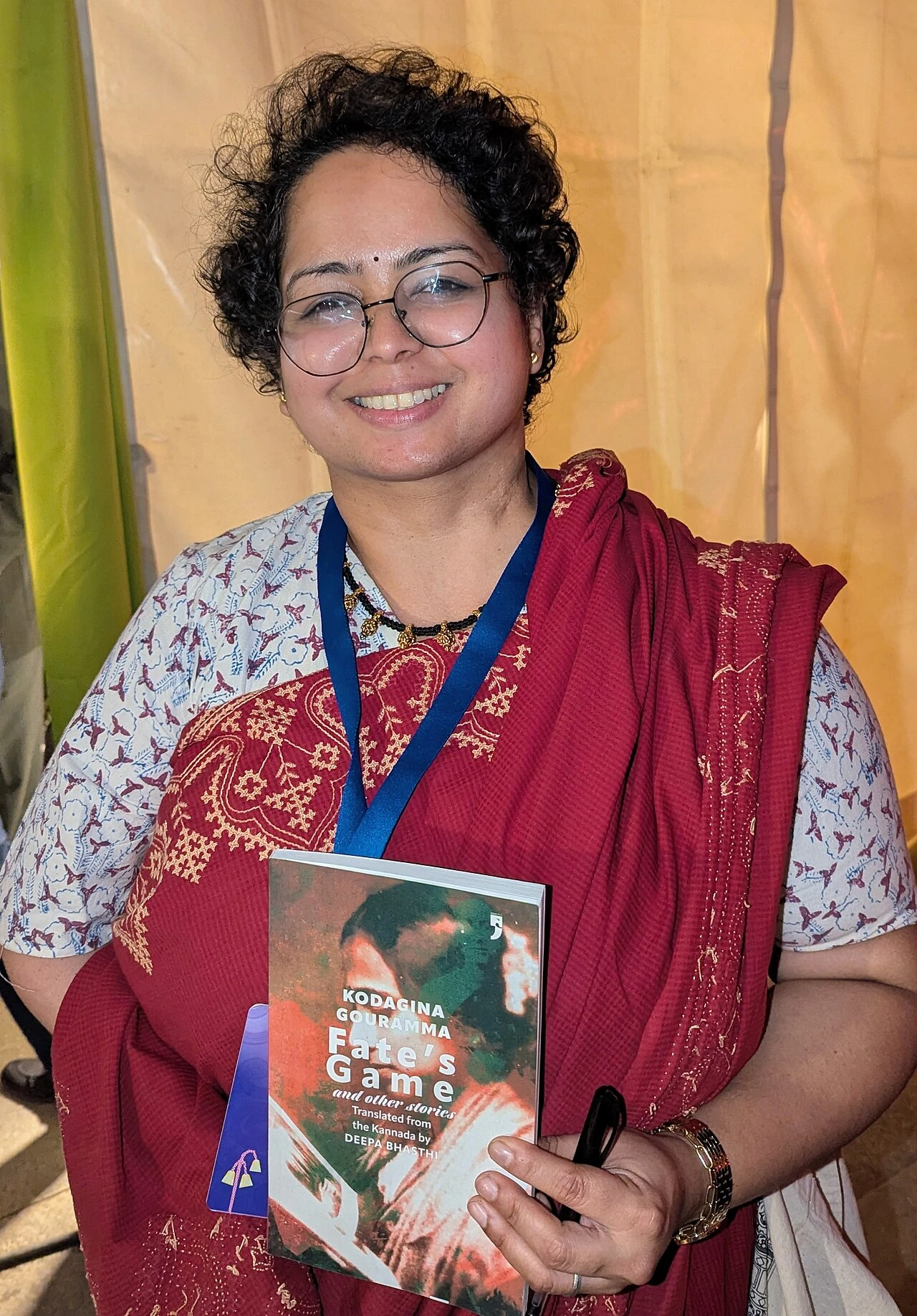
In 2026, the commercial afterlife of Heart Lamp moved beyond the usual language of literary prestige. Translation rights reached thirty languages, UK paperback sales rose above 31,000 copies and the book’s independent publisher was able to point to a fivefold increase after the International Booker victory. Deepa Bhasthi’s English translation was not a supporting service around that success. It was the piece of creative infrastructure that allowed foreign editors, booksellers and readers to encounter Banu Mushtaq’s Kannada stories.
The expansion has made Bhasthi a test case for the economics of literary translation. A translator can create the edition through which a work enters the international rights market, yet contracts often treat the labour as a fee rather than an ownership stake. Thirty downstream editions increase the value of the originating translation even when some are prepared directly from Kannada. The question is whether compensation and authority will reflect that contribution.
The rights boom after recognition
The prize created demand, but the durability of the market will depend on direct translation capacity, transparent royalties and publishers willing to preserve linguistic texture. Bhasthi’s method was commercially important because it rejected neutral global English. The book travelled with the grain of Kannada still present. That result gives publishers evidence that accessibility and standardisation are not the same thing.
Deepa Bhasthi’s place in the 2025 cultural record rests on a precise fact: Her translation of Heart Lamp made Kannada fiction legible to a broad international readership. Precision matters here.
It keeps the story from dissolving into broad claims about influence and makes it possible to examine the actual exchange between craft and reach. The result is a leadership story, but not the corporate kind; it is leadership exercised through standards, choices and the refusal to make the work less itself. For Deepa Bhasthi, that is the question the No. 8 profile must answer.
A story enters world literature
FigureAsia’s annual signal is deliberately specific: Her translation of Heart Lamp made Kannada fiction legible to a broad international readership. The moment also reveals timing, because audiences, platforms and institutions were newly prepared to receive an idea that might have been marginalized in another season. A strong annual record has a before and an after: the field understood one set of possibilities before Deepa Bhasthi, and a wider or more difficult set once the work arrived. The relevant change was a movement from presence to consequence, when the work began altering expectations around literary translation rather than merely satisfying them.
A serious business reading asks who owns the underlying work, who controls the next use, where value accumulates and whether the artist’s bargaining position improves after success. For rights holders and partners, a distinctive creative identity lowers one kind of market risk—indifference—while increasing another: the work may resist easy categorization. The durable asset is not a single spike of visibility. It is the leverage to choose collaborators, protect development time and reach audiences without accepting every available intermediary. The economics of literature and translation are often discussed after the art, as though finance, rights and release strategy were external forces rather than part of the conditions of possibility. For Deepa Bhasthi, this economic equation helps explain the No. 8 record without turning the ranking into its own argument.
Translation is broader than language here. It includes format, publicity, genre expectation, platform interface and the critical vocabulary through which a new audience first encounters the work. International reach is built through editing, translation, rights acquisition, review culture, bookselling and the slow construction of readership, a chain in which each participant can widen the audience or quietly redefine the work for convenience. The achievement is that partial readings did not empty the work; they generated enough curiosity for the work’s own structure to recover authority. Deepa Bhasthi’s year demonstrates that circulation is creative strategy, because the order, place and framing of encounters affect what audiences believe they have received.
Editors, translators and the long route out
The work gains force from proportion: spectacle and quiet, intimacy and distance, familiarity and surprise are calibrated rather than piled together. The signature remains recognizable because it is made from decisions, not surface branding, and decisions can adapt when format, budget or collaborator changes. Craft at this level is less about ornament than control—knowing where to place pressure, where to remove explanation and where to trust an audience to complete the work. In literary translation, technique is inseparable from judgment; every visible choice carries a chain of discarded alternatives that the audience will never see. For Deepa Bhasthi, this craft question helps explain the No. 8 record without turning the ranking into its own argument.
No book, story or translated text reaches the public through individual will alone, and the mythology of the lone genius can hide the management problem at the center of ambitious culture. That balance is a form of organizational design, requiring enough hierarchy to keep direction and enough permeability for an unexpected contribution to improve the whole. Deepa Bhasthi’s case is instructive because the public result still reads as authored even though authorship was carried through many hands and institutions. At scale, clarity is generous: collaborators need to understand what cannot be compromised, what remains open and where their expertise should change the original plan.
The base in India matters without becoming destiny, shaping access, language and reference while leaving room for collaboration and reception elsewhere. A conventional profile would march through biography until success appears inevitable; Deepa Bhasthi’s record is more useful when read as a sequence of changing creative problems. The 2025 chapter feels earned precisely because it does not erase the uncertainty, detours and less visible labor that made the present range possible. The important milestones are therefore not only debuts and prizes, but the moments when a creative method survived a larger team, a wider public or a more exposed failure.
Against easy legibility
The word auteur can become a decorative label, but authorship has practical meaning when it helps a large network make consistent choices under pressure. That recognition creates responsibility, since a familiar signature can open doors for harder ideas or become a shield against honest evaluation. Deepa Bhasthi has leverage because audiences recognize a standard before they can always name its components, giving the work continuity across changing formats. Authority also depends on listening. A leader who cannot be changed by collaborators eventually converts a living practice into an expensive imitation of earlier confidence.
This is also a regional industry story, since one visible breakthrough can change what commissioners, publishers, studios, venues or investors consider capable of crossing borders. The work’s international life matters partly because it changes the direction of reference: audiences do not encounter Asia only as subject matter, but as a source of form and standards. FigureAsia’s perspective treats Asia as a network of languages, industries, histories and diasporas whose exchanges are as consequential as their movement toward Western institutions. Cultural influence becomes structural when the next artist enters a field with one fewer assumption to disprove, and that is the larger regional stake in Deepa Bhasthi’s year.
The 2025 response suggests that recognition deepened because the work offered both an immediate point of contact and enough density to support argument, memory and return. Audience is often rendered as a number, yet the more consequential question is what kind of attention Deepa Bhasthi asked people to practice. The strongest evidence of durability will be whether the audience keeps using the work—to think, argue, imitate, teach or make something the original artist did not predict. The relationship is not one-way. Audiences reinterpret, translate, circulate and sometimes resist a work, exposing meanings that production and marketing could not fully control.
That sequence matters. When recognition follows substance, it can provide time and bargaining power; when recognition leads, it often produces a brittle career organized around external approval. For partners, the lesson is equally demanding: supporting a distinctive voice requires patience with development, disagreement and outcomes that may not fit a familiar performance dashboard. The artist’s task is not to reject infrastructure but to understand its incentives well enough to use reach without allowing the institution to become the subject of the work. Institutions entered Deepa Bhasthi’s 2025 story as amplifiers and gatekeepers, conferring resources and legitimacy while bringing their own preferences about what can be named, sold and celebrated. The 2025 response suggests that recognition deepened because the work offered both an immediate point of contact and enough density to support argument, memory and return. Audience is often rendered as a number, yet the more consequential question is what kind of attention Deepa Bhasthi asked people to practice. The strongest evidence of durability will be whether the audience keeps using the work—to think, argue, imitate, teach or make something the original artist did not predict. The relationship is not one-way. Audiences reinterpret, translate, circulate and sometimes resist a work, exposing meanings that production and marketing could not fully control.
The afterlife on the shelf
Every profile of success is vulnerable to hindsight, which removes the credible possibility that the work could have been ignored, misunderstood, delayed or reduced to a safer version. Deepa Bhasthi’s year remains interesting because the work preserved a productive instability instead of resolving every tension into a marketable message. The wiser lesson is to separate method from formula: keep the seriousness of preparation, the quality threshold and the courage to edit, but do not reproduce the visible outcome. There is also the risk of representation, especially when one artist is asked to stand for a country, diaspora or entire field that contains far more disagreement than a global market prefers.
Awards, festivals, platforms, publishers, museums, labels and studios are not neutral pipes; each builds a different public around the same creative act. The 2025 case shows how infrastructure can serve authorship when prestige is treated as a resource to deploy, not a destination at which creative risk should stop. The most useful institution is one that makes itself less visible in the final experience while remaining rigorous about labor, access, rights and public accountability. Deepa Bhasthi gained authority because institutional recognition met an already coherent practice, rather than manufacturing importance from an empty campaign.
The third measure is artistic. The next work must be allowed to complicate the story told here, because a career that merely confirms a profile has already begun to narrow. For the surrounding field, Deepa Bhasthi’s influence will be meaningful if resources move toward original practitioners instead of only toward copies of the most visible result. The opportunity is to use scale selectively, expanding the conditions of work rather than allowing new demand to shrink the range of acceptable choices. By 2026, durability should be visible in more than residual publicity: stronger terms, wider creative options, deeper collaboration and a public willing to follow beyond the familiar signal.
The profile is ultimately less about prominence than consequence: what became newly possible, newly visible or newly difficult to dismiss after the work entered public life. What remains is the harder form of influence—the work other people make differently because Deepa Bhasthi demonstrated that a different choice could hold the center. The 2025 signal will eventually recede into a longer career, but the shift it recorded has already entered the expectations of audiences and institutions. The business value follows from that distinction rather than replacing it, because singular work creates the kind of attention that platforms can distribute but rarely manufacture on command.
The next contract
Bhasthi’s next influence will be measured less by another ceremony than by the terms translation attracts after Heart Lamp. Better fees, royalties, credit, development time and access to rights negotiations would turn an exceptional success into an industrial precedent. The book has already proved that Kannada can travel without being sanded smooth. The publishing business must now prove that the people who make that travel possible can retain a fair share of the value.