
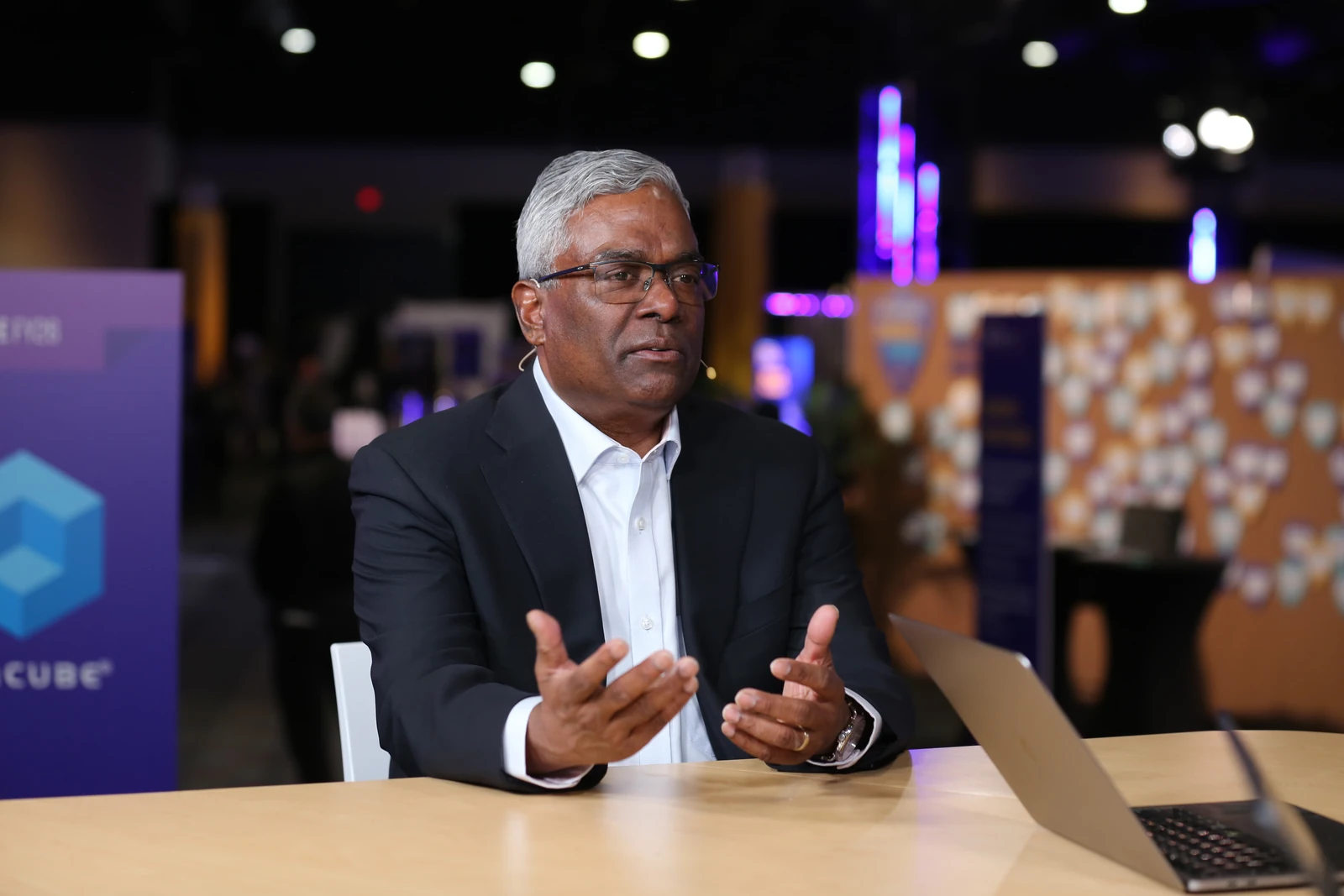
George Kurian enters fiscal 2027 with something enterprise technology leaders rarely obtain at the same time: strategic relevance and financial proof. NetApp finished fiscal 2026 with record revenue, gross profit, operating income, cash flow from operations and free cash flow. Fourth-quarter revenue reached $1.95 billion, up 12 per cent, while full-year revenue rose 5 per cent to $6.93 billion. All-flash array revenue hit a quarterly record of $1.2 billion, public cloud revenue reached $182 million, and annual billings climbed to $7.21 billion. Those figures do more than mark a good year. They show that a company once viewed mainly through the mature storage cycle has found a credible place in the enterprise AI build-out.
Kurian, NetApp’s chief executive since 2015, has spent much of his tenure making that transition possible. He inherited a business exposed to hardware replacement cycles, cloud migration and questions about whether specialist storage vendors could retain influence as hyperscalers absorbed more infrastructure value. His response was not to abandon NetApp’s core. It was to turn the ONTAP operating system, data services and cloud integrations into a control layer for information that moves among on-premises systems and public clouds. In 2026, that hybrid premise has become more valuable because enterprise AI does not begin with a model. It begins with locating, governing, protecting and continuously feeding the data on which models and agents depend.
The economics have caught up with the strategy
The importance of the fiscal 2026 result is its breadth. NetApp did not produce its records through one unusually strong product line while sacrificing the rest of the business. Growth came from all-flash arrays, public cloud services and a broader mix of software-led data infrastructure. The company also returned $1.36 billion to shareholders through repurchases and dividends. That combination of reinvestment and distributions gives Kurian room to argue that AI positioning is being funded by an established cash engine rather than by a speculative expansion of the cost base.
Fiscal 2027 guidance raises the standard. NetApp expects revenue between $7.325 billion and $7.575 billion, with a non-GAAP operating margin between 29.1 and 30.1 per cent. The range implies that management believes the company can grow while preserving the operating discipline investors now associate with the franchise. This is not a trivial promise. AI infrastructure markets can tempt incumbents into costly product proliferation, aggressive sales incentives and acquisitions that obscure the return on capital. Kurian’s leadership test is to pursue a larger opportunity without weakening the economics that have restored confidence in NetApp.
His advantage is that enterprise data problems are becoming more complicated at precisely the moment customers want simpler operating models. Large organisations rarely have one clean data estate. They have decades of applications, multiple clouds, regulated workloads, unstructured files, duplicated records and security policies that differ by jurisdiction. Training and retrieval systems make those inconsistencies more consequential. A model can only be reliable if the organisation knows which data is authoritative, who can use it and how it changes. NetApp’s proposition is that the same platform can connect performance, governance, resilience and mobility across those environments.
From storing data to preparing it
The AI Data Engine is the clearest expression of Kurian’s next act. Launched in 2026 and co-engineered with NVIDIA, it is designed to create a continuously updated metadata catalogue across an enterprise estate, then help teams discover, govern and prepare information for production AI. Paired with the AFX architecture, which separates storage performance and capacity, the offer attempts to collapse several preparation steps into one managed system. The commercial idea is straightforward: if NetApp can shorten the distance between raw enterprise information and a governed AI workload, it can participate in a larger share of the customer’s technology budget.
That requires more than technical integration. Data readiness is an operational outcome, not a product label. Customers will judge the platform by how quickly they can bring a retrieval system into production, how consistently access rules follow data across locations, and whether infrastructure teams can improve utilisation without introducing another management silo. Kurian must ensure that the AI Data Engine works as a genuine extension of ONTAP rather than as an isolated feature created for the current investment cycle. The stronger the integration, the harder it becomes for customers to reproduce NetApp’s value by combining cheaper storage with separate catalogue and security tools.
NetApp’s close ties with NVIDIA, Cisco and the largest public clouds are therefore strategic, but they also demand careful positioning. Partnerships allow the company to appear inside broader AI factory designs without funding every part of the stack. They also expose it to powerful counterparties that want to own more of the customer relationship. Kurian has to make NetApp indispensable enough to remain a platform, while open enough to avoid being treated as a proprietary island. Native integrations across Amazon Web Services, Microsoft Azure and Google Cloud are central to that balance because customers increasingly expect policy and performance to travel with the data.
Cyber resilience is part of the AI sale
Kurian’s strategy also benefits from the convergence of AI investment and cyber resilience. More accessible data can create more value, but it also enlarges the surface exposed to attackers, accidental leakage and compromised identities. The rise of agents adds another layer: software can now retrieve and act on information at machine speed. NetApp’s long experience in snapshots, recovery and ransomware protection gives it a practical bridge between innovation and control. For boards, the ability to restore critical information and enforce consistent governance may be as important as model performance.
This is where leadership discipline matters. Security claims must survive operational stress, not merely product demonstrations. Kurian needs product teams to design resilience into new AI workflows, sales teams to avoid overselling automation, and support organisations to handle incidents across mixed environments. A serious failure would damage more than one product line because NetApp is asking customers to trust a unified platform with increasingly valuable data. The company’s record gives it credibility, but platform expansion concentrates reputational risk as well as opportunity.
There is also a consumption question. NetApp’s Keystone storage-as-a-service model and public cloud services can make spending more flexible, but customers still compare their total cost with hyperscaler-native alternatives and commodity hardware. AI workloads may grow rapidly, yet they can also be intermittent and difficult to forecast. Kurian must demonstrate that disaggregated performance, efficient capacity scaling and unified management generate measurable savings over the life of a workload. If the economic argument is vague, AI enthusiasm will not prevent procurement teams from demanding price concessions.
Asia is a proving ground, not a side market
Kurian’s Indian background and global career add resonance to his position in FigureAsia’s ranking, but the more important regional connection is commercial. Asian enterprises span some of the world’s most demanding data environments: banks with strict sovereignty requirements, manufacturers connecting factories and design systems, telecommunications groups handling huge volumes, and governments modernising services without abandoning legacy infrastructure. Many operate across jurisdictions and clouds. That makes hybrid data management especially relevant, while placing a premium on local support, channel quality and compliance.
Winning that opportunity requires more than translating a global sales playbook. NetApp must help customers modernise at different speeds and within different capital constraints. In mature markets such as Japan, reliability and installed-base transitions are central. In India and Southeast Asia, rapid digital growth creates opportunities for cloud-linked architectures but also fierce price competition. Kurian’s organisation needs partners that can deliver sector knowledge and deployment discipline, not only capacity. The platform thesis will be credible when customers can achieve consistent outcomes despite this regional complexity.
Kurian must also manage a mature company’s talent transition. NetApp’s future depends on engineers and sellers who understand software, cloud economics, AI pipelines and security as deeply as traditional storage. The company cannot simply rebrand existing expertise. It has to recruit new capabilities while retaining the operational knowledge that makes enterprise systems dependable. The best evidence of cultural change will be product velocity that does not compromise quality, and sales incentives that reward recurring customer value rather than short-term infrastructure shipments.
The next measure is durable share gain
The fiscal 2026 records have resolved one question: NetApp can grow and expand its relevance without discarding its profitable core. Fiscal 2027 must answer a harder one. Can Kurian translate that positioning into durable share gains as AI spending moves from pilots to governed production? The indicators will include adoption of AFX and the AI Data Engine, growth in cloud and service-based revenue, all-flash momentum, margins, and the size of workloads that customers consolidate under NetApp management.
His leadership has been characterised by architectural patience. Rather than chase each technology wave, Kurian has made the case that data must remain available, protected and portable regardless of where applications run. AI has made that proposition more urgent. Yet urgency can attract competitors and compress the time available to establish a standard. NetApp now needs to execute with the speed of a challenger while preserving the reliability of an incumbent.
Kurian’s achievement is that NetApp no longer has to defend its relevance to the AI era in theory. Record results, a stronger product architecture and major ecosystem partnerships provide tangible evidence. The next stage will be judged by whether customers see data readiness as a strategic layer worth paying for, and whether NetApp converts that willingness into sustained growth and returns. If Kurian can do both, his reinvention of the company will move from a successful recovery to a durable platform transition.