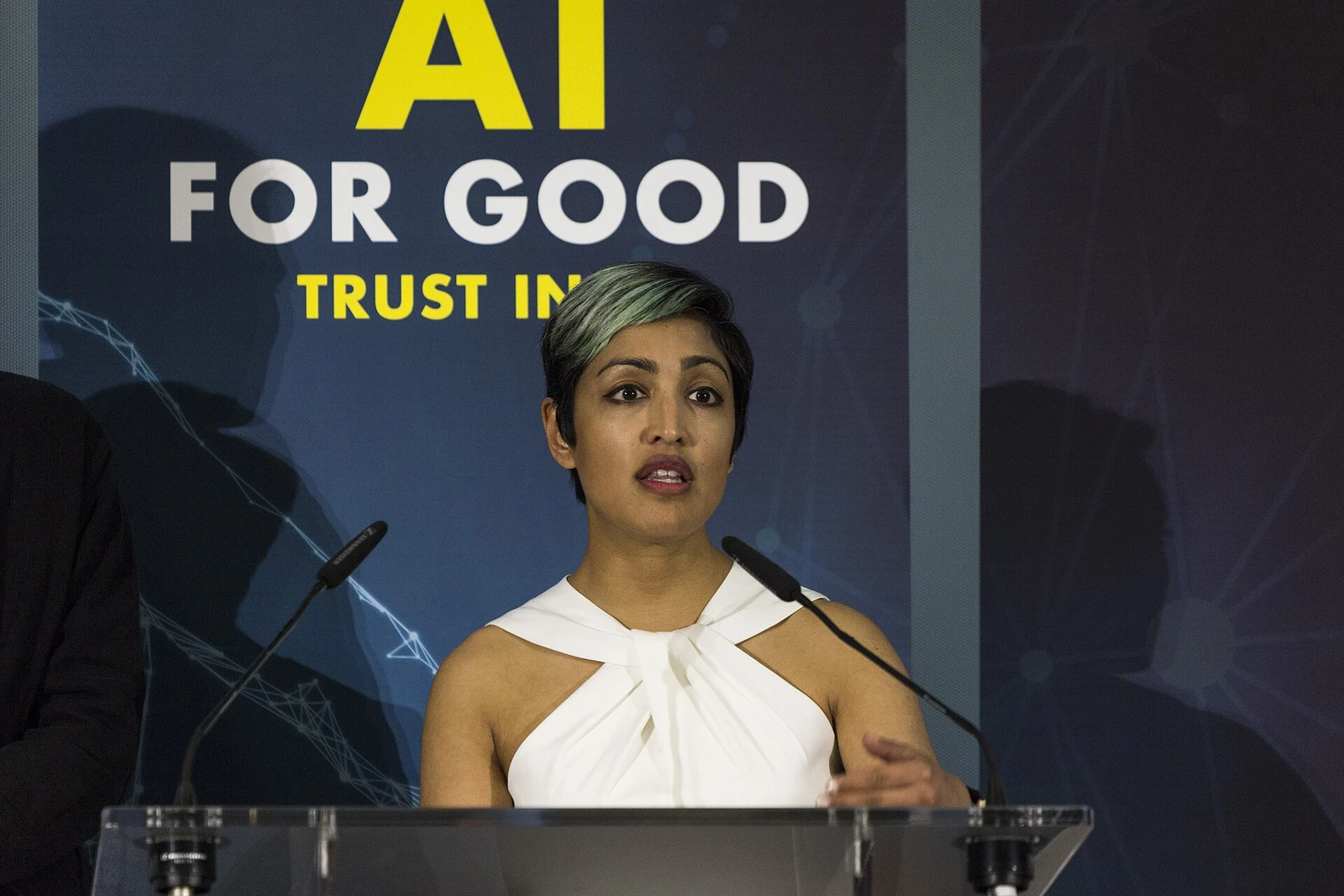
Rumman Chowdhury is taking artificial-intelligence evaluation from a public-interest practice into a commercial operating model. She stepped down as chief executive of the nonprofit Humane Intelligence in 2025 and now leads Humane Intelligence PBC, a public-benefit company building test and evaluation services for frontier and agentic AI. The nonprofit continues separately under an executive director.
The distinction matters because the two organisations answer different questions. Public challenges and red-team events can expose broad social and technical weaknesses. Enterprises need continuous testing inside their own systems, infrastructure for repeatable evaluation and specialists who can help fix failures before deployment.
Chowdhury sees a market between model benchmarks and traditional consulting. Humane Intelligence PBC offers modular evaluation, hosted infrastructure and forward-deployed expertise. The business can make rigorous testing practical for companies that lack internal teams. It can also face a familiar audit problem: the client paying for an assessment may prefer a favourable answer.
Evaluation is becoming operational infrastructure
AI systems no longer sit only in research laboratories. They summarise customer records, recommend medical actions, screen content, generate code and operate tools. A model can perform well on a public benchmark while failing in a company’s language, data and workflow. Evaluation therefore needs to be specific to context.
Enterprises must test factuality, bias, privacy, security, robustness and task completion. Agentic systems add permissions, tool use and multi-step behaviour. A failure may emerge only when several components interact. One score cannot represent those risks.
Humane Intelligence can create value by turning policy goals into tests. A bank may need to know whether an assistant provides unsuitable financial guidance. A manufacturer may test whether an agent can bypass approval to change equipment. The evaluation should produce evidence, thresholds and remediation priorities.
Operational infrastructure means tests run repeatedly, not only before a launch. Models, retrieval data and software change. Monitoring can detect drift and trigger a deeper assessment. Chowdhury’s business will be durable if evaluations become part of product release and risk management rather than a one-time certification.
The buyer and the public may want different answers
A commercial client controls budget, timing and access. It may define the scope narrowly, delay publication or reject a recommendation that threatens a product launch. The evaluator needs mechanisms to protect professional judgement without breaching legitimate confidentiality.
Humane Intelligence PBC should publish a conflict policy and standard terms that preserve the right to report material risks to appropriate decision makers inside the client. Evaluation teams should not be compensated according to whether a system passes. Sales leaders should not edit technical findings.
Governance can include an independent review committee for disputed high-risk conclusions. Staff need a protected escalation route and clear rules for withdrawing from an engagement. The public-benefit structure can support these choices, but legal form alone does not create independence.
Clients also deserve procedural fairness. Findings should include evidence, uncertainty and a chance to correct factual errors. A company may disagree with the evaluator’s risk tolerance without suppressing data. Separating observations from recommendations makes the debate more useful.
Methods must be transparent enough to trust
Evaluation vendors can create their own opacity. Proprietary scores may look authoritative while hiding task selection, sample size and judgement. Customers should know what was tested, how cases were generated, which evaluators participated and what the system was allowed to access.
Chowdhury can publish methodological frameworks while keeping client data private. Test libraries should describe intended use, limitations and coverage. Results need confidence intervals or qualitative uncertainty where appropriate. A pass should apply only to the tested version and environment.
Human evaluation requires diverse and well-supported participants. Red-team contributors can identify harms that technical teams miss, particularly across cultures and languages. They should be compensated, protected from disturbing material and credited according to agreed terms. Their work is skilled labour, not free community feedback.
Automated evaluators can increase scale but introduce another model’s biases and blind spots. They should be calibrated against human judgement and audited for drift. A system should not certify itself through an opaque chain of model-generated scores.
Remediation separates evaluation from criticism
Enterprises pay not only to learn that a system fails, but to decide what to do next. Humane Intelligence’s commercial model includes forward-deployed support, giving specialists a chance to work with product and risk teams. That can accelerate fixes and create recurring revenue.
The evaluator should avoid becoming the sole implementer of every remediation it recommends. Otherwise it can benefit financially from finding more problems or validating its own fix. Customers may choose the firm for support, but an independent team should retest material changes.
Remediation can occur at several layers: training data, model selection, instructions, retrieval, permissions, user interface and human review. The least expensive effective control may be outside the model. An agent that can make a high-risk transaction may need a simple approval gate more than another round of tuning.
Chowdhury should measure whether fixes persist. A closed finding can reappear after a model update or product expansion. Versioned test suites and regression checks make evaluation part of engineering discipline.
The market needs standards without a single gatekeeper
Regulators and procurement teams increasingly ask for evidence that AI risks are managed. Independent evaluators can supply that evidence, but the industry should not depend on one vendor’s badge. Competition and interoperability help prevent a new assurance monopoly.
Humane Intelligence PBC can map its tests to regulatory and standards frameworks while keeping raw evidence available to customers. Exportable results allow internal auditors, regulators or another evaluator to review the work. Common formats reduce the cost of changing providers.
Certification language should be careful. An evaluation cannot prove that a complex system is safe in every use. It can show performance under defined conditions and whether controls met a threshold. Marketing should not turn that limited conclusion into a general guarantee.
Professional standards may eventually include qualifications, peer review and rules for conflicts. Chowdhury can help shape them by sharing lessons and supporting a community larger than her company. Her prior nonprofit work gives her credibility, but the commercial entity must earn it anew.
Frontier models and enterprise systems require different tests
Public discussion often focuses on the capabilities of the largest models. Enterprises assemble systems from a model, proprietary data, software and human processes. The combined application can create risks that do not appear in the base model.
A frontier evaluation may examine dangerous capabilities, manipulation or systemic misuse. An enterprise evaluation may focus on privacy, discrimination, reliability and permission boundaries in a specific workflow. Both matter, but methods and responsible decision makers differ.
Humane Intelligence should define which layer it is assessing and avoid transferring a result across layers without evidence. A strong base model does not make an insecure application safe. A carefully governed application may reduce some weaknesses in a general model.
Agentic systems make the boundary especially important. Tool descriptions, identity, memory and approval rules can be more consequential than model intelligence. Evaluation must include realistic integration and failure recovery, not only conversation.
Global evaluation needs local knowledge
AI systems used in Asia operate across languages, legal systems and social contexts that are often underrepresented in development data. A response considered harmless in one market can reinforce discrimination or violate a local rule in another. Direct translation does not solve the problem.
Chowdhury’s Next-Billion AI work and public red-team experience provide a foundation for broader participation. The company should build paid regional networks and partner with local researchers rather than fly in a universal checklist. Evaluation cases need to reflect actual services and vulnerable groups.
Data residency and confidentiality may require local infrastructure or controlled environments. Forward-deployed teams can work inside client systems, but access should be limited and monitored. The evaluator itself becomes a holder of sensitive model and failure information.
Regional diversity can improve the global product. Weaknesses discovered in low-resource languages or unfamiliar contexts often reveal general problems in reasoning, retrieval and interface design. A commercial model can finance that work if customers value the expanded coverage.
The two Humane Intelligence organisations need clear boundaries
The nonprofit and public-benefit company share a name and a founder history, which can create confusion about funding, data and endorsement. They should publish separate governance, leadership and financial relationships. Participants in a nonprofit event must know whether their contributions may support a commercial product.
Collaboration can be valuable. Public challenges can identify emerging risks, while commercial work can build infrastructure and implementation expertise. Any transfer of methods or data needs consent and fair terms. The nonprofit’s reputation should not become a sales asset without accountability.
Chowdhury is no longer chief executive of the nonprofit, and public descriptions should reflect that. Accurate roles protect the authority of its current leadership and allow the company to be judged on its own performance.
Rumman Chowdhury has helped turn red teaming into a visible part of AI governance. Commercialisation can make evaluation continuous, better funded and closer to engineering. It can also soften the independence that gave the work value. Humane Intelligence PBC will earn trust if its methods are inspectable, conflicts are controlled and its evaluators can deliver an inconvenient conclusion even when a powerful client wants to ship.