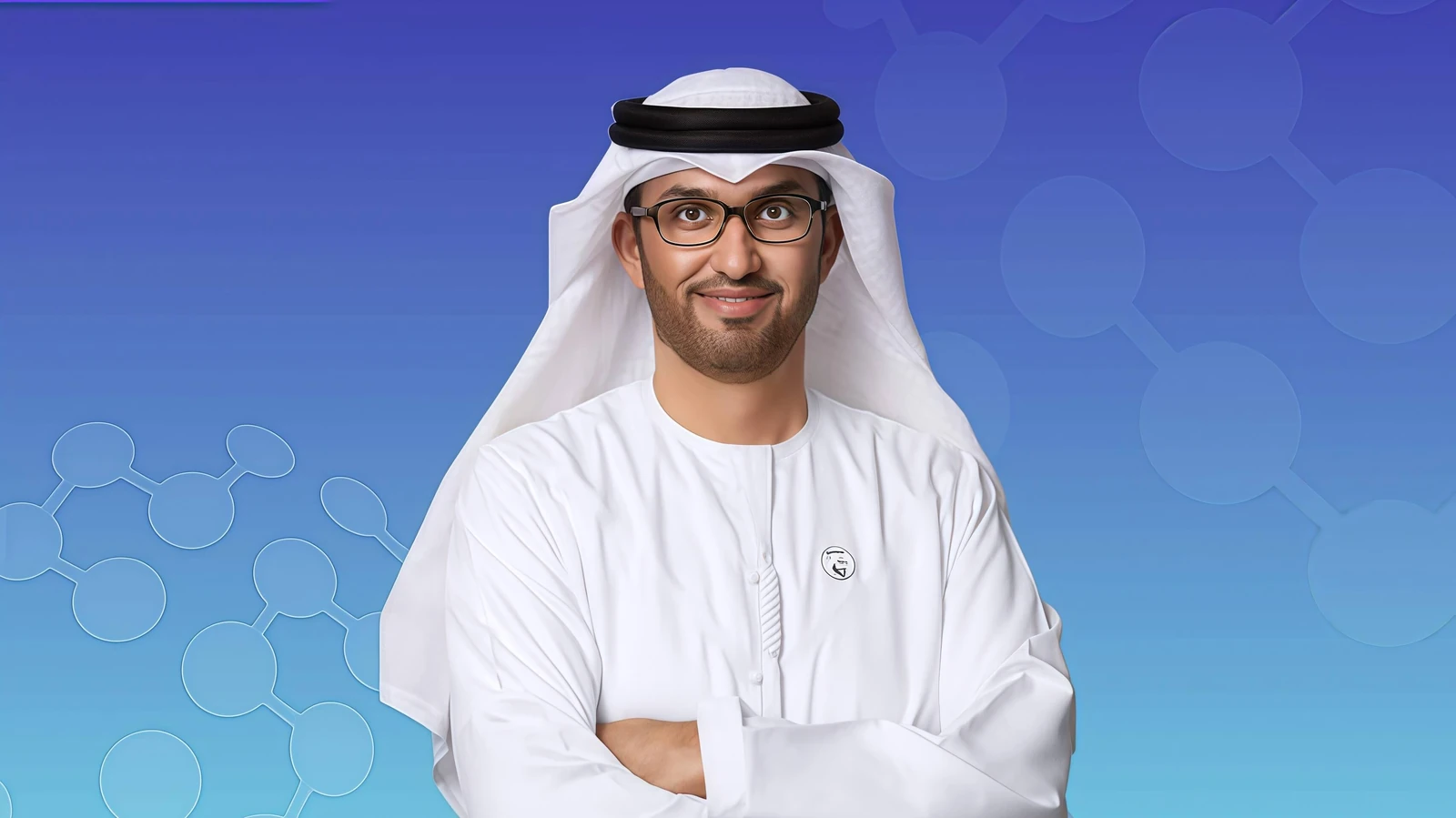
Sultan Ahmed Al Jaber is attempting one of the most consequential acts of corporate synthesis in global energy: expanding an oil company, assembling an international gas and chemicals portfolio, financing renewable power at utility scale and defending the proposition that all of these choices belong to the same transition.
That proposition now carries more capital, political authority and commercial reach than at any earlier point in his career. Abu Dhabi National Oil Company is working through a $150 billion investment programme for 2026 to 2030. It is moving towards five million barrels a day of crude-production capacity by 2027, developing new gas resources and building a liquefied-natural-gas business with global trading ambitions. XRG, the international investment platform launched from ADNOC in late 2024, is being shaped into a top-tier gas and chemicals owner. Masdar, which Al Jaber chairs, has reached 65 gigawatts of renewable capacity and is targeting 100 gigawatts by 2030.
The scale is striking. The tension is more important. Al Jaber’s strategy rests on the belief that the energy transition will be additive for longer than many Western policy frameworks once assumed: rising demand from Asia, emerging markets, artificial intelligence, cooling and industrialisation will require more electrons, more molecules and more infrastructure at the same time. In his formulation, the practical task is to reduce the emissions intensity of today’s system while financing the system that eventually replaces much of it.
This is not a neutral reading of the future. It is a thesis with enormous consequences for shareholders, governments and the climate. If Al Jaber is right, companies that retain low-cost hydrocarbon capacity while building global positions in gas, chemicals, power and technology will control the most valuable junctions of a disorderly transition. If he is wrong, ADNOC risks committing exceptional amounts of capital to assets whose economic lives depend on demand persisting longer than climate policy can comfortably allow.
Few executives sit so directly at the intersection of that argument. Al Jaber is the UAE’s Minister of Industry and Advanced Technology, ADNOC’s managing director and group chief executive, Masdar’s chairman and XRG’s executive chairman. He also presided over COP28, where governments agreed for the first time to transition away from fossil fuels in energy systems. His leadership cannot be assessed by separating those roles. The concentration of them is the story.
The strategy begins with an unfashionable demand forecast
Al Jaber’s view of energy is grounded less in the preferred end-state of the transition than in the physical requirements of getting there. Global oil consumption, in ADNOC’s planning assumptions, remains above 100 million barrels a day into the 2040s. LNG and electricity demand both rise sharply. Renewable capacity expands, but so do data centres, air travel, petrochemicals, urban cooling and the industrial needs of economies whose per-capita energy use remains far below that of the developed world.
This produces the governing phrase of the Al Jaber era: reinforcement rather than replacement. The world, he argues, cannot remove dependable supply faster than it builds alternatives without creating volatility, inflation and political resistance. Energy security is not treated as a temporary interruption to climate policy. It is treated as a condition of climate policy’s durability.
The argument has commercial force in Asia. India is already ADNOC’s largest LNG market and its leading LPG customer. Japan remains a cornerstone crude buyer and a long-term partner across shipping, gas and chemicals. Manufacturing economies from South Korea to Southeast Asia need secure fuel and feedstock while investing heavily in electrification. Their governments are unlikely to accept a transition architecture that makes development contingent on scarcity.
Al Jaber understands that this is not merely a commodity opportunity. It is a relationship business shaped by contracts, ports, pipelines, storage, shipping and state confidence. A cargo can be bought on the spot market. A twenty-year energy partnership is built through reliability during periods when the market is least convenient.
That distinction helps explain why ADNOC continues to invest across the chain rather than choosing a narrower identity. The company wants to be able to sell crude, LNG, refined products, petrochemical feedstocks, lower-carbon fuels and, through associated platforms, clean power. It is positioning Abu Dhabi not as a producer defending a single resource but as a supplier capable of following the customer’s changing energy mix.
The danger is that “all forms of energy” can become a strategic permission slip. Every incumbent asset can be described as necessary, every expansion as orderly and every difficult choice deferred to a later decade. A credible additive transition therefore requires more than building additional capacity. It requires evidence that the new system is growing fast enough to displace emissions, not simply to sit beside them.
ADNOC is being expanded as an industrial system
ADNOC under Al Jaber is no longer best understood as a conventional national oil company. It is an integrated industrial and financial architecture. Upstream production supplies gas processing, refining, petrochemicals and export businesses. Specialist subsidiaries have been listed on the Abu Dhabi Securities Exchange, creating market valuations, dividend streams and a broader investor constituency while the state retains strategic control.
The group’s approved capital expenditure of $150 billion for 2026 to 2030 captures the magnitude of the next phase. ADNOC is seeking to raise crude-production capacity from about 4.85 million barrels a day to five million by 2027. Abu Dhabi’s conventional reserves have been assessed at 120 billion barrels of oil and 297 trillion cubic feet of gas. New investment is also moving into sour gas, unconventional resources, chemicals, logistics and infrastructure.
This is expansion by design, not defensive maintenance. Al Jaber’s judgment is that advantaged barrels will remain valuable even as the market becomes more selective. ADNOC’s reserves are large, production costs are comparatively low and the carbon intensity of operations is below that of many competing basins. In a world that still consumes oil but penalises inefficient supply, those characteristics should move Abu Dhabi’s production towards the front of the economic queue.
The logic is compelling at the asset level. It is less complete at the system level. A barrel produced with fewer operational emissions still releases carbon when its products are used. Lower methane leakage, electrified facilities and carbon capture can improve the production footprint materially; they do not eliminate the climate consequence of sustained consumption.
Al Jaber’s answer is essentially competitive rather than abstentionist. Demand should be met by the lowest-cost, lowest-intensity producers while policy, technology and consumer behaviour reduce total demand over time. That approach protects the UAE’s economic position and can lower the emissions intensity of marginal supply. It also assumes that market share can be separated from aggregate volume—a distinction that becomes harder to maintain when several advantaged producers pursue expansion simultaneously.
The company’s industrial role inside the UAE complicates any simple call to shrink. ADNOC is a fiscal engine, a buyer from local manufacturers, an employer, a technology customer and a platform for national capability. Its in-country value programme directed $17.7 billion into the domestic economy in 2025, and the group has been instructed to drive a further $60 billion over the following five years. For Al Jaber, energy policy is inseparable from industrial policy.
That is why the measure of his leadership cannot be reduced to barrels. The deeper project is to convert resource advantage into durable productive capacity before the relative value of the resource changes. The question is whether diversification is genuinely being built around oil wealth or merely attached to it.
Gas is the bridge—and XRG is the vehicle
Natural gas sits at the centre of Al Jaber’s global strategy because it can satisfy several objectives at once. It supports electricity systems with growing intermittent renewable power, replaces coal in some markets, supplies industrial heat and fertiliser, and gives producers access to long-duration contracts with energy-importing economies. It also carries lower combustion emissions than coal without being a zero-carbon fuel.
Ruwais LNG is intended to make that position tangible. The 9.6 million-tonne-a-year project will more than double the UAE’s LNG production capacity and has been designed with electric-drive liquefaction powered by cleaner electricity. By July 2026, more than 90 per cent of its capacity had been committed under long-term agreements, including substantial volumes for Japanese customers. The project gives ADNOC a newer, more flexible export base at precisely the moment Asian buyers are re-evaluating security of supply.
ADNOC has also combined the LNG marketing activities of ADNOC Gas and XRG with its trading capabilities in a single Abu Dhabi platform. The ambition is to manage 47 million tonnes a year of marketable LNG by 2035. This matters because the most valuable LNG companies do more than own production. They optimise portfolios across destinations, shipping routes, contract tenors and price systems.
XRG extends that logic beyond the UAE. Launched with an enterprise value of more than $80 billion and subsequently enlarged through transactions, it is being organised around global gas, chemicals and energy solutions. Investments have reached US LNG, Egyptian upstream gas, Azerbaijan and Turkmenistan. The company is targeting a top-five integrated global gas and LNG position by 2035.
The platform gives Al Jaber strategic freedom that a domestic operating company would struggle to achieve. ADNOC can remain the steward of Abu Dhabi’s resources while XRG buys international positions, forms partnerships and assembles portfolios across jurisdictions. It is a structure designed for speed, patient capital and transactions too large to be treated as peripheral.
But gas cannot be granted permanent transitional status by assertion. Its climate value depends on what it displaces, how much methane escapes across the chain and how long infrastructure remains in use. LNG facilities and shipping fleets are long-lived assets. Contracts that improve energy security in the 2030s may also slow substitution in the 2040s if their economics are built around high utilisation.
Al Jaber’s gas strategy will therefore be judged on operational performance and portfolio adaptability. A genuinely transitional gas business should be capable of lowering methane aggressively, incorporating carbon management, serving variable power systems and surviving lower utilisation without requiring policy to protect sunk capital. Scale alone cannot answer those tests.
Chemicals turn hydrocarbons into a longer industrial wager
XRG’s chemicals strategy reveals another dimension of Al Jaber’s thinking. Even if transport becomes less oil-intensive, demand for materials can continue to grow with urbanisation, healthcare, food systems, electronics and consumer goods. Converting hydrocarbons into higher-value products offers a route beyond the fuel barrel.
The planned combination around Borouge Group International, together with XRG’s acquisition of Covestro, is intended to create a top-three global chemicals platform. The portfolio would span commodity polyolefins, performance materials and more specialised applications. It places Abu Dhabi capital deeper inside manufacturing supply chains rather than leaving the country exposed primarily to upstream prices.
Strategically, the move is understandable. Chemicals provide technology, customer relationships and margins that can be less directly linked to crude cycles. Covestro adds advanced materials and a substantial European operating base. Borouge brings advantaged feedstock and exposure to Asian growth. Together they could create a company with the scale to rationalise production, fund research and serve global manufacturers.
The acquisition also tests whether XRG can operate as more than a state-backed dealmaker. Buying a complex international company is easier than integrating it. European industrial assets face high energy costs, demanding regulation and pressure to decarbonise production. Specialist-material customers value technical collaboration and consistency, not only cheap feedstock. Capital discipline must survive the political satisfaction of global expansion.
There is also an environmental issue that cannot be solved by moving oil from combustion into materials. Plastics and chemical products have essential uses, but they create waste, recycling and lifecycle-emissions problems of their own. A durable chemicals platform will need to make circularity, lower-carbon feedstocks and product design part of its economics rather than treat them as reputational additions.
Al Jaber is betting that demand for materials will outlast demand growth for transport fuels. The bet may be correct. Its quality will depend on whether XRG builds capabilities that remain valuable in a low-carbon industrial system, not simply assets that absorb more hydrocarbons.
Masdar gives the transition real scale—and a demanding benchmark
Masdar is the strongest evidence that Al Jaber’s transition argument is backed by more than future promises. Founded in 2006, the company has spent two decades building renewable projects across developed and emerging markets. Its portfolio reached 65 gigawatts in early 2026, supported by $45 billion of investment, and it plans to deploy another $30 billion to $35 billion during the decade on the way to 100 gigawatts.
This is no longer a showcase initiative. Masdar owns and develops solar, onshore wind, offshore wind, storage and other clean-energy assets across a geographically diversified portfolio. It has become a global infrastructure investor with the financial capacity to compete for large projects and the political reach to enter markets where long-term partnerships matter.
The company also broadens the UAE’s commercial exposure. Renewable power generates contracted returns, creates relationships with utilities and governments, and provides a platform for storage, green hydrogen and round-the-clock clean-energy systems. As electricity becomes a larger share of final energy demand, Masdar places Abu Dhabi on the growth side of the transition rather than only on the incumbent side.
Yet the comparison with ADNOC is unavoidable. Masdar’s 65 gigawatts are substantial, but renewable capacity and oil production cannot be placed on a single scale. The cash flows, utilisation rates, energy density and emissions effects are different. More importantly, growth in clean power does not automatically neutralise growth in hydrocarbon output.
Al Jaber’s credibility therefore depends on linkage. Can Masdar’s expansion accelerate the decarbonisation of ADNOC’s operations and customers? Can clean electricity support lower-carbon industrial products, hydrogen and data infrastructure? Can investment be directed towards markets where renewable projects displace expensive or high-emitting generation rather than simply satisfy incremental demand?
If Masdar remains a successful parallel company, the UAE will own valuable assets on both sides of the energy system. If its capabilities begin to reshape the economics of the hydrocarbon and industrial portfolio, Al Jaber will have built something more consequential: an integrated transition platform rather than a diversified hedge.
The carbon record is improving, but the accounting boundary matters
ADNOC has made measurable progress on the emissions it controls directly. Its upstream greenhouse-gas intensity was reported at roughly seven kilograms of carbon-dioxide equivalent per barrel of oil equivalent in 2025. Methane intensity stood at 0.05 per cent. Clean-power imports, operational efficiency, electrification and carbon-management projects have reduced or avoided millions of tonnes of emissions.
These improvements matter. Methane is a potent greenhouse gas, and reducing leakage can produce rapid climate benefits. Electrifying offshore operations and using lower-carbon power can materially improve production. Digital monitoring can identify equipment failures and inefficiencies earlier. An industry that will continue operating for years should not be excused from making every unit cleaner.
But intensity is a ratio. A company can reduce emissions per barrel while total emissions remain high or rise as production expands. The majority of lifecycle emissions from oil and gas occur when products are used by customers, outside the operational boundary on which producer targets often concentrate.
This is the central analytical weakness in the claim that “lower-carbon oil” resolves the transition problem. It improves the ranking of supply; it does not settle the required path of demand. Carbon capture can address selected industrial streams and perhaps some combustion, but deployment remains far below the scale implied by continued global fossil-fuel use.
Al Jaber has set ADNOC a net-zero ambition for its operations by 2045. The target is earlier than that of many peers and backed by significant capital. Still, its credibility will depend on transparent absolute emissions, methane measurement, project-level economics and the treatment of growth. A transition plan becomes convincing when investors can see which assets thrive under tighter carbon constraints and which would lose capital.
The strongest version of Al Jaber’s strategy would treat low operational intensity as a minimum qualification, not the final answer. It would use the cash generated by advantaged hydrocarbons to fund businesses capable of compounding after hydrocarbon demand peaks, while refusing investments that require indefinitely rising consumption to earn their cost of capital.
Artificial intelligence is both tool and customer
Al Jaber has made artificial intelligence a defining part of ADNOC’s operating identity. The group uses more than 200 AI tools and dozens of robotics applications across wells, maintenance, logistics and decision-making. It has trained tens of thousands of employees and introduced agentic systems intended to interpret operating data and recommend action across the production portfolio.
The commercial purpose is practical. Predictive maintenance reduces shutdowns. Better reservoir modelling can improve recovery. Automated inspections can keep people away from hazardous environments. Trading systems can optimise cargoes, and procurement tools can expose cost patterns across a group of unusual scale. ADNOC says AI has helped cut unplanned shutdowns by half.
For Al Jaber, however, AI is not only a productivity instrument. It is also a source of energy demand. Data centres require electricity, grid connections, cooling and backup capacity. Semiconductor fabrication and advanced manufacturing add further industrial loads. XRG’s mandate explicitly includes infrastructure linked to digital growth, particularly in the United States.
This creates a powerful strategic loop. ADNOC uses AI to make energy production more efficient, while XRG and Masdar invest in the energy systems required by AI. Abu Dhabi’s wider technology ecosystem adds capital, data-centre ambition and partnerships. Energy and computation are being treated as mutually reinforcing national advantages.
The opportunity is large, but the investment case requires discrimination. Forecasts for data-centre power demand are rising rapidly, and scarcity can encourage indiscriminate building. Projects must still secure grid capacity, customers, chips, water, planning permission and acceptable returns. The winners will not be those that merely attach “AI” to energy infrastructure; they will be those that understand where demand is contracted and where it is speculative.
Al Jaber’s advantage is the ability to coordinate molecules, electrons, capital and government relationships. His risk is believing that coordination can repeal project economics. AI may be a secular demand driver, but it will also reward cheaper computation and greater efficiency. Infrastructure built on permanently escalating power intensity could become vulnerable to the very innovation it serves.
Asia is where energy statecraft becomes commercial strategy
ADNOC’s Asian relationships reveal how Al Jaber combines corporate leadership with statecraft. During a July 2026 visit to Japan, the group signed a fifteen-year agreement to supply one million tonnes a year of Ruwais LNG to INPEX and broadened cooperation with Mitsui across crude, gas, shipping, chemicals and international investment. Japan buys roughly a third of its crude imports from the UAE, giving the relationship strategic depth beyond any individual contract.
India offers a different growth profile. It is a fast-expanding energy consumer, a major refining and manufacturing centre and an increasingly important market for LNG, LPG, chemicals and clean infrastructure. ADNOC can serve Indian demand from multiple parts of its portfolio while UAE capital participates in the country’s renewable build-out.
These partnerships are not transactional in the narrow sense. Importing countries want confidence that supply will continue through geopolitical shocks. Producing countries want durable demand, investment access and a role in downstream value creation. Al Jaber packages those interests through government-to-government relationships and company-level execution.
The model can move faster than corporate diplomacy alone. A national champion with sovereign backing can align ports, financing, industrial zones and strategic agreements. It can tolerate long payback periods when a relationship creates broader national value. That patience is a competitive advantage in infrastructure.
It also raises governance questions. Commercial choices can be difficult to evaluate when national strategy, foreign policy and company returns overlap. A project may be justified by energy security, diplomatic influence, industrial development or financial return, each measured on a different timetable. Investors in listed ADNOC subsidiaries need clarity about where those objectives meet and where they diverge.
Al Jaber’s leadership is strongest when state capacity enables execution that private capital would struggle to coordinate. It is most exposed when strategic importance becomes a substitute for transparent economics.
COP28 made the contradiction impossible to avoid
Al Jaber’s presidency of COP28 placed an oil-company chief executive at the centre of global climate diplomacy. The appointment created an obvious credibility challenge. It also forced a conversation that climate policy had often managed through separate rooms: producers, consumers, financiers and governments were asked to negotiate while acknowledging that the existing energy system could not disappear by declaration.
The resulting UAE Consensus included the first negotiated call to transition away from fossil fuels in energy systems, alongside commitments to triple renewable capacity and double the rate of energy-efficiency improvement by 2030. The language was historically significant because almost 200 governments accepted it. It was also carefully constructed, leaving implementation to national policy and preserving debate over pace, finance and technology.
For Al Jaber, the agreement became both achievement and obligation. He cannot credibly invoke the pragmatism of COP28 only to defend continuing supply. The same pragmatism requires accelerating the alternatives, reducing methane, mobilising capital for emerging markets and accepting that transition ultimately means lower unabated fossil-fuel use, not merely cleaner production growth.
His dual identity can be an asset if it allows him to move capital and industrial capability faster than a conventional climate diplomat. It can be a liability if every transition measure is calibrated to preserve incumbent value. The test is not whether he can reconcile the language rhetorically. It is whether ADNOC’s portfolio decisions remain economically robust under the outcome he helped negotiate.
This is why governance matters as much as ambition. Al Jaber’s overlapping roles provide unusual execution power, but they also concentrate the framing of success. Independent scrutiny, consistent disclosure and clear capital-return thresholds are essential when the same leader can influence industrial policy, corporate investment, renewable strategy and international energy diplomacy.
The transition will judge the allocation, not the narrative
Sultan Ahmed Al Jaber has built his career around the idea that false choices are expensive. Energy security and climate action, industrial growth and decarbonisation, hydrocarbons and renewables: he presents each pair as a problem to be integrated rather than a side to be chosen.
That instinct has produced institutions of unusual scale. ADNOC is becoming more commercial, technologically ambitious and international. XRG can deploy sovereign capital across gas, chemicals and infrastructure. Masdar has become a serious global renewable-power owner. The UAE has developed the capacity to participate in almost every major layer of the energy system.
But integration does not abolish trade-offs. Capital committed to one asset cannot be committed twice. Long-term LNG contracts improve security but shape future demand. Production growth can lower unit costs while increasing exposure to transition risk. Operational decarbonisation can be genuine while leaving end-use emissions unresolved. A large renewable portfolio can create value without cancelling the consequences of a larger hydrocarbon portfolio.
The decisive measure of Al Jaber’s leadership will therefore be the sequence of allocation. Does cash from today’s advantaged production build tomorrow’s dominant businesses quickly enough? Does gas displace higher-emitting energy or simply prolong fossil dependence? Do chemicals become circular and technologically differentiated? Does Masdar change the group’s centre of gravity? Does AI improve capital efficiency or become another reason to overbuild?
Al Jaber is building ADNOC for an energy transition that adds before it subtracts. That may be the most realistic description of the present decade. It cannot become a permanent exemption from subtraction.
If the portfolio he is assembling can generate competitive returns while global emissions fall and unabated fossil demand eventually contracts, he will have shown how a resource state can convert incumbent advantage into post-carbon power. If it depends on every energy curve rising indefinitely, the strategy will have diversified the form of exposure without changing its direction.
The difference will not be decided by the elegance of the narrative. It will be decided, asset by asset, by where Sultan Ahmed Al Jaber puts the next dollar.