
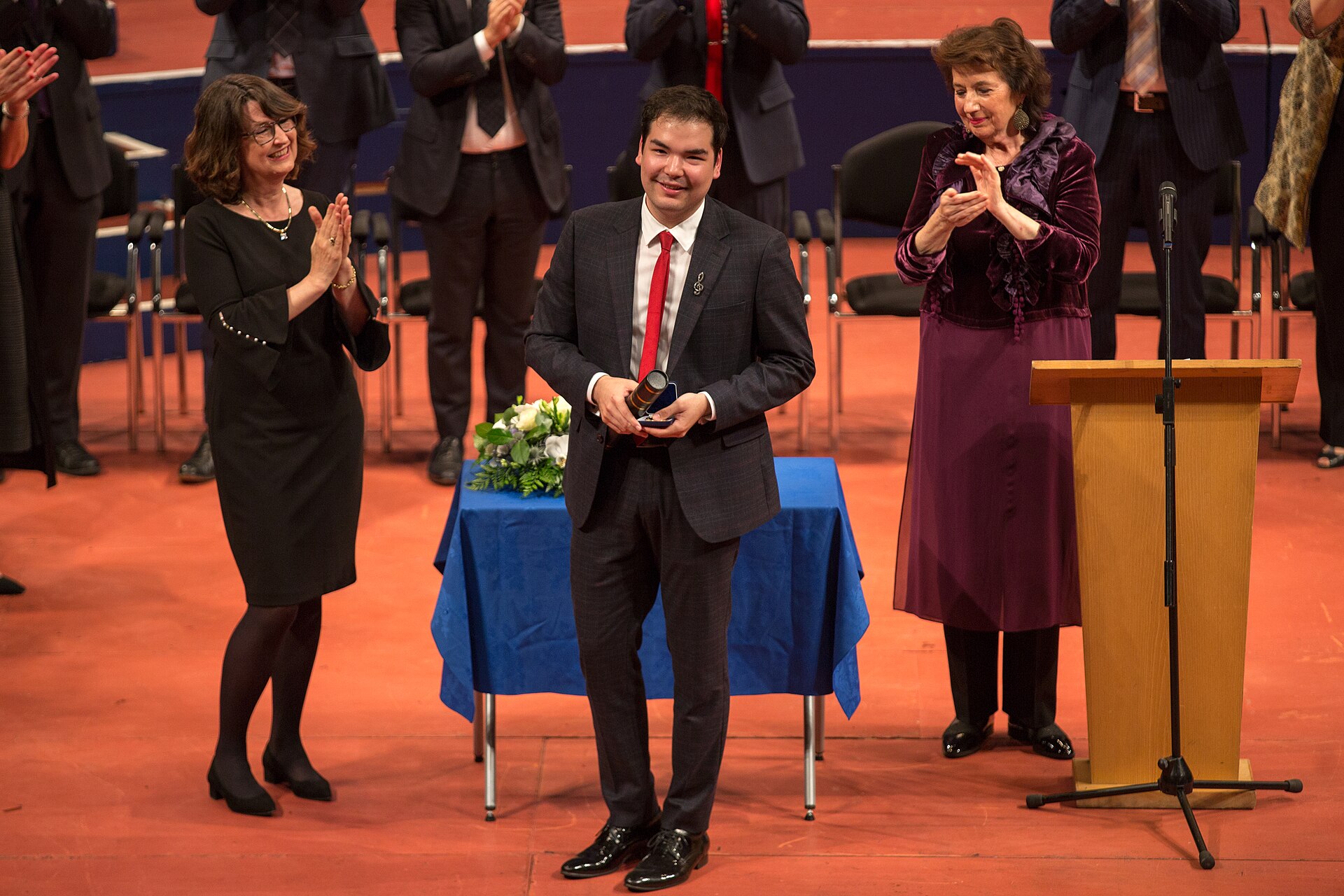
FigureAsia 35 Under 35 · Music
Alim Beisembayev
Age 27 · Classical piano performance and recording · Kazakhstan
Kazakh pianist carrying competition authority into a finished Mozart concerto recording
- Age at the edition eligibility date
- 27
- Field
- Music
- Country or region
- Kazakhstan
- FigureAsia U35 Assessment
- 85.0 / 100
Profile
Career and documented record
Alim Beisembayev's 2025–26 record shows the conversion of competition recognition into a substantive professional catalogue. On 15 May 2026 he released an album of Mozart's Piano Concertos Nos. 25 and 26 with the ORF Vienna Radio Symphony Orchestra and conductor Howard Griffiths. Two complete large-scale works give the assessment more than a recital excerpt or future announcement. The credits also establish a clear boundary: Beisembayev is responsible for the solo interpretation, while conductor, orchestra and production team remain equal contributors to the recorded result.
Born in Kazakhstan and trained in Moscow and London, Beisembayev won the 2021 Leeds International Piano Competition together with its audience and contemporary-performance prizes. Those honours explain his professional platform but do not substitute for current work. During 2025 he completed international recitals and orchestral appearances as his 2023–25 term as a BBC New Generation Artist concluded. The new Mozart recording demonstrates how the earlier opportunity developed into repertoire, repeat engagements and permanent documentation.
His authorship is interpretive rather than compositional. In late Mozart concertos, responsibility lies in structural pacing, articulation, tonal balance and continuous negotiation with the ensemble. FigureAsia therefore credits individual agency without presenting a concerto as a solitary product. Beisembayev's Kazakhstan birth and international career establish a clear Central Asian-global route in a field where that representation remains significant. His audience is more specialist and his current recorded catalogue smaller than those of higher-ranked classical artists, which limits impact and durability scores. The selection nevertheless rests on completed, technically demanding work and a credible post-competition trajectory, not on potential.
FigureAsia selection
Why Alim Beisembayev is on the list
FigureAsia selected Alim Beisembayev because the 2026 Mozart album provides current, attributable work of substantial scale. Recording Concertos Nos. 25 and 26 requires sustained solo, structural and ensemble responsibility across two complete works. His 2025 recitals and orchestral appearances add a live record, showing that the assessment period contains both permanent repertoire and completed performance rather than an announcement or institutional title alone.
The 2021 Leeds honours and BBC New Generation Artist term are treated as trajectory evidence, not as substitutes for the current contribution. Beisembayev receives credit for the piano interpretation while Howard Griffiths, the ORF Vienna Radio Symphony Orchestra and the production team retain their collaborative roles. His Kazakhstan birth and international training create a material Central Asian-global connection. A specialist audience and relatively compact catalogue keep the ranking measured, but the completed Mozart project demonstrates that competition-era recognition has developed into a serious recording and international performance practice.
Verified work
The 2025–26 record
International performance record
Completed recitals and orchestral appearances as his 2023–25 BBC New Generation Artist term concluded.
Mozart concerto album
Released complete recordings of Piano Concertos Nos. 25 and 26 with the ORF Vienna Radio Symphony Orchestra.
Post-competition development
Converted the Leeds platform into repeat international engagements and a substantial recorded-repertoire project.
Field context
The work in its field
Major competition wins create visibility, but they do not by themselves establish a durable classical career. The more meaningful test is whether a pianist converts that platform into repertoire choices, repeat engagements and recordings that preserve interpretive decisions. Beisembayev's 2025 performances and 2026 Mozart album provide that conversion. Concerto work also demands careful attribution: the soloist's agency is real, but inseparable from conductor, orchestra and production partners.
FigureAsia U35 Assessment
Assessment breakdown
85.0out of 100
Substantive 2025–2026 contribution
16.9 / 20
A complete two-concerto Mozart album and a record of 2025 performances provide substantial current work across recording and live interpretation.
Verified impact
12.2 / 15
Leeds honours, BBC selection and repeat international engagements across several seasons verify meaningful specialist consequence, while general-audience reach remains comparatively narrow.
Originality and distinction
8.5 / 10
His late-Mozart interpretations emphasise structural clarity and restraint in complete concertos, distinguishing the work from a display-led continuation of competition repertoire.
Industry influence
8.5 / 10
An active Kazakhstan-born soloist broadens Central Asian visibility within the international classical-piano circuit, though organisational influence remains developing at present.
Individual agency
8.4 / 10
The solo piano role carries direct interpretive responsibility, with Howard Griffiths, the orchestra and recording team retained as essential co-makers.
Durability and demonstrated trajectory
4.2 / 5
Competition success, BBC development, repeat recitals and a substantial concerto recording show a credible progression towards a durable international practice.
Asian significance and global relevance
4.7 / 5
Kazakhstan birth, training across Moscow and London and international performance establish a clear Central Asian-global connection grounded in completed work.
Artistic authorship and interpretive agency
6.7 / 8
His agency is interpretive, expressed through pacing, articulation, tone and ensemble negotiation within scores composed by Mozart and a collaborative setting.
Musical and technical execution
5.6 / 6
Two late Mozart concertos demand sustained structural, tonal and technical command as well as responsive coordination with conductor and orchestra.
Repertoire or recorded-work significance
5.5 / 6
The album adds two complete concertos to a young recorded catalogue, giving the current period a substantial and coherent repertoire statement.
Audience and field transmission
3.8 / 5
International recitals, orchestral appearances and institutional broadcast routes transmit the work effectively within classical music, albeit to a specialist audience.