
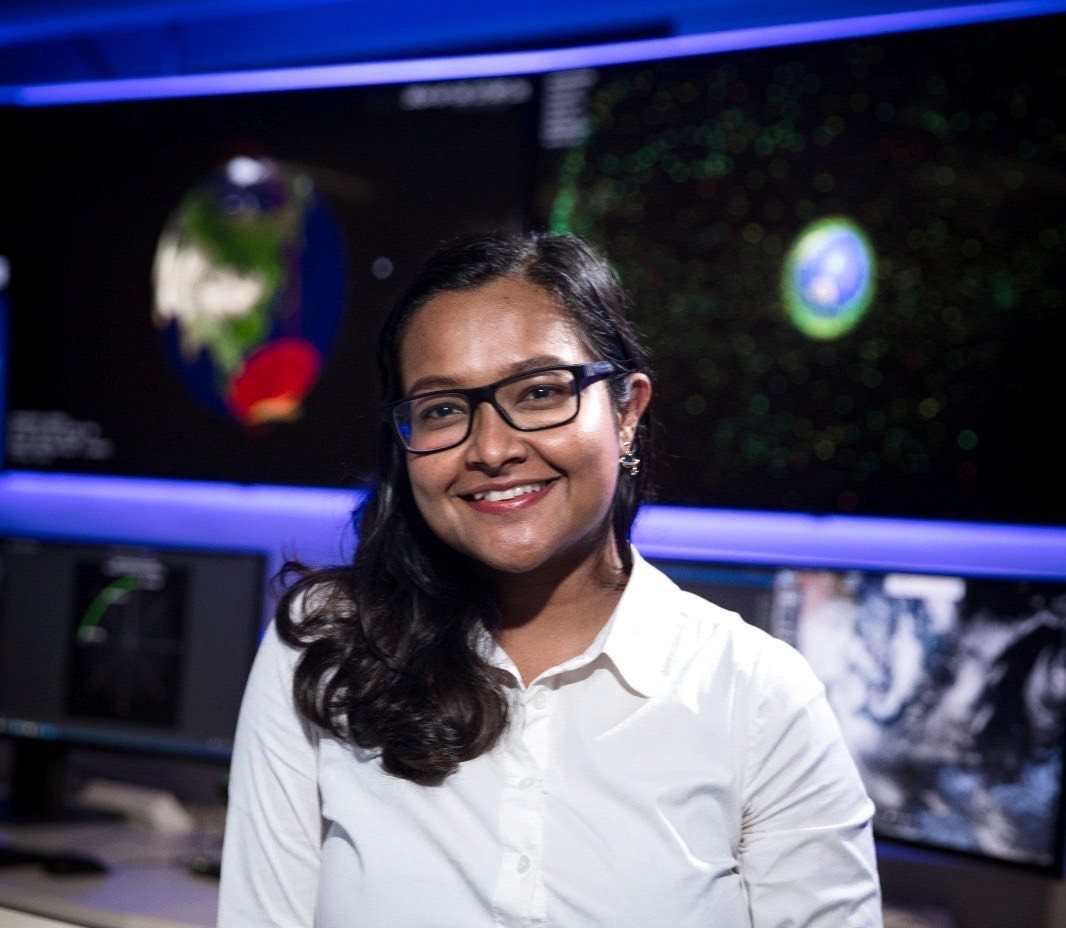
FigureAsia 35 Under 35 · Science
Minduli Wijayatunga
Age 25 · Safe autonomous spacecraft guidance · Sri Lanka / United States
Developer of constrained reinforcement-learning guidance for low-cost far-range spacecraft rendezvous.
- Approximate age at the edition eligibility date
- 25
- Field
- Aerospace engineering
- Country or region
- Sri Lanka / United States
- FigureAsia U35 Assessment
- 82.5 / 100
Profile
Career and documented record
Autonomous spacecraft rendezvous normally relies on expensive sensing and carefully designed trajectories. Minduli Wijayatunga's 2025 work used reinforcement learning to guide far-range approaches from angle-only observations while enforcing safety and observability constraints.
Across the reported Monte Carlo tests, the method reduced delta-v by 22.31% against the suboptimal comparison. The achievement is not simply a lower fuel number: the policy has to preserve enough geometry to infer relative motion and remain inside a safe operational envelope.
At the 18 July 2026 selection cutoff, Wijayatunga was a visiting scientist at MIT, based in Cambridge, and due to take up her Illinois aerospace appointment in August. The 2025 paper belongs to the research record that won her that platform, not to an already established Illinois faculty programme. Its relevance to lower-cost spacecraft is clear; flight qualification will still require hardware-in-the-loop testing, failure analysis and mission-specific assurance.
FigureAsia selection
Why Minduli Wijayatunga is on the list
Wijayatunga is selected for joining learning, control theory and orbital mechanics without treating safety as an afterthought. The study produces a measurable resource gain inside explicit physical constraints.
Verified work
The 2025–26 record
Safe rendezvous guidance
First-authored constrained reinforcement learning for far-range angle-only spacecraft approaches.
22.31% delta-v reduction
Reported lower fuel use than the study's suboptimal baseline across Monte Carlo tests.
MIT-to-Illinois transition
Visiting scientist at MIT at the selection cutoff; scheduled to join Illinois Aerospace as an assistant professor in August 2026.
Field context
The work in its field
Angle-only rendezvous is difficult because the spacecraft must manoeuvre both to approach and to make the hidden range state observable. Fuel efficiency cannot be separated from safe geometry.
FigureAsia U35 Assessment
Assessment breakdown
82.5out of 100
Substantive 2025–2026 contribution
15.6 / 20
First-authored constrained reinforcement learning for far-range angle-only spacecraft approaches.
Verified scientific impact
11.7 / 15
The method reports a meaningful efficiency gain in a technically constrained problem central to autonomous space operations.
Originality and distinction
8.4 / 10
The distinction lies in combining learning-based guidance with observability and safety constraints under angle-only sensing.
Field influence
8.1 / 10
Researchers in safe autonomous spacecraft guidance now have a stronger result to test, extend or challenge because of this contribution.
Individual agency
8.5 / 10
Wijayatunga is first author of the 2025 article, with Roberto Armellin and Harry Holt as co-authors; the evidence supports leadership of the study, not sole ownership or an already-running Illinois faculty programme.
Durability and trajectory
4.4 / 5
The article extends a multi-year trajectory-design record. That research line continued during Wijayatunga's 2025–26 MIT visiting appointment and was set to anchor her Illinois lab after the August 2026 start.
Asian significance and global relevance
4.4 / 5
Sri Lankan citizen raised in Colombo and now conducting spacecraft-guidance research in the United States.
Evidential validity and reproducibility
6.8 / 8
Monte Carlo tests and explicit baselines support the claim while flight performance remains unasserted.
Advance in scientific knowledge
5.9 / 7
The study clarifies how learning can exploit manoeuvres that preserve both approach efficiency and state observability.
Translational or methodological utility
4.4 / 5
The approach could reduce sensing and fuel requirements for small-satellite servicing and formation missions.
Responsible research stewardship
4.3 / 5
Safety constraints are embedded in the method, and the profile keeps simulation separate from mission qualification.