
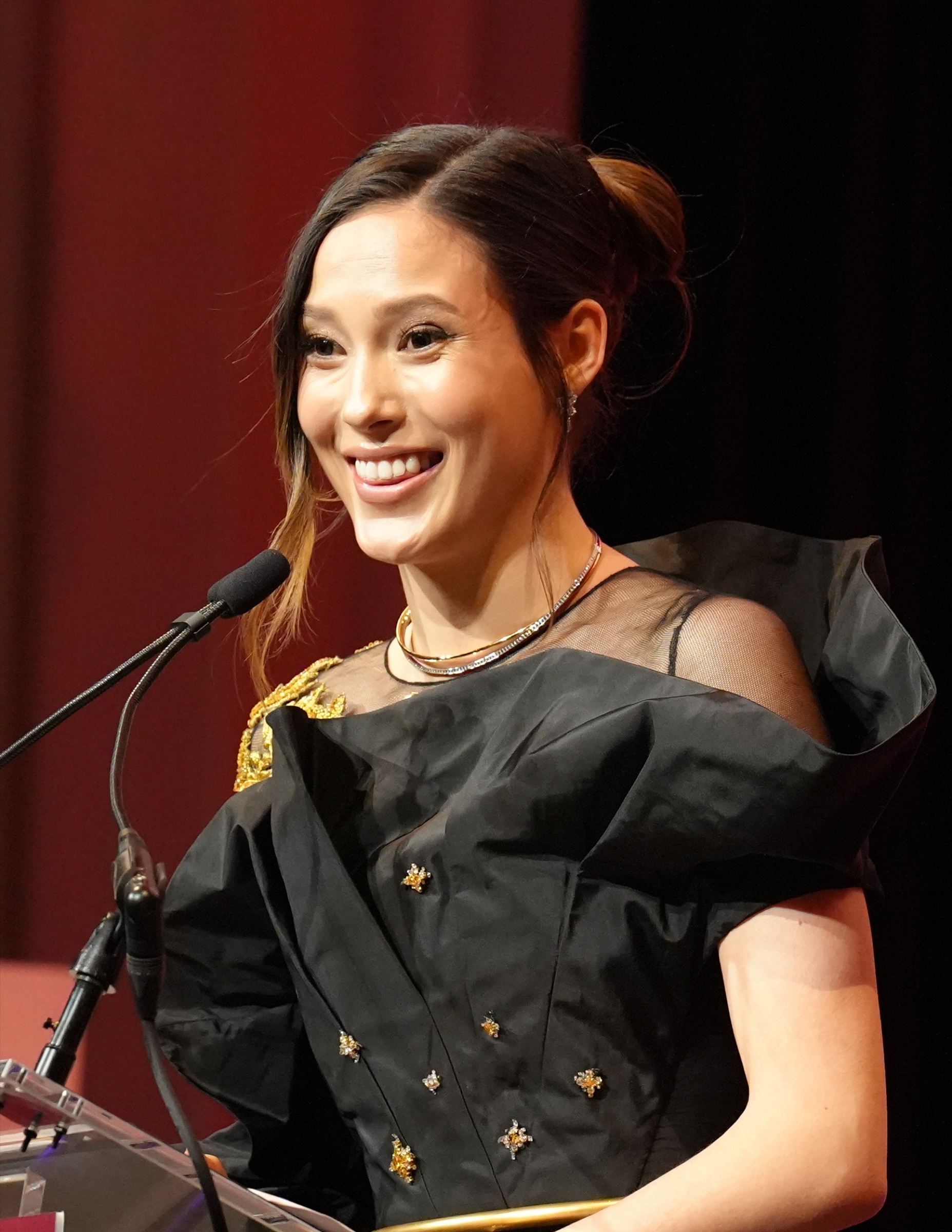
FigureAsia 35 Under 35 · Sports
Eileen Gu
Age 22 · Halfpipe, slopestyle and big air · China
Three-discipline Olympic medallist with repeatable technical range
- Age at the edition eligibility date
- 22
- Field
- Freestyle Skiing
- Country or region
- China
- FigureAsia U35 Assessment
- 98.5 / 100
Profile
Career and documented record
Eileen Gu entered all three park-and-pipe disciplines at the 2026 Olympic Winter Games and left each with a medal. She won halfpipe gold with 94.75 points, retained the title she had won at the previous Games and became the first woman to defend an Olympic freeski halfpipe championship. Silver followed in slopestyle, where the margin to the winner was 0.38 points, and in big air. The three results brought her Olympic record to three gold and three silver medals from six starts.
That range defines Gu's work. Halfpipe rewards the amplitude, execution and sequence of repeated aerial tricks; slopestyle adds rails and a longer course; big air concentrates risk into individual jumps. Contesting all three requires separate technical choices and different responses to judging and course conditions. Gu represents China in international competition and has publicly documented Chinese and American heritage, placing her within FigureAsia's pan-Asian scope. Her current responsibility is that of a freestyle skier on the international circuit, where every run carries both individual authorship and immediate scoring consequence. The importance of her 2026 programme lies in repeatable range rather than medal accumulation alone. She retained a title in one specialist field and remained within fractions of gold in another, while completing the full three-event schedule. For freestyle skiing beyond her own results, that performance supplied a current benchmark for athletes who refuse the usual division between event specialisms.
FigureAsia selection
Why Eileen Gu is on the list
FigureAsia selected Gu because her 2026 Olympic programme combined a retained championship with verified excellence across every park-and-pipe format. Halfpipe gold met the edition's highest standard on its own. The two silver medals then established that the performance was not confined to one course design, one sequence of tricks or one judging problem. Across three starts, her choices, execution, landings and scores were directly attributable to her, satisfying the assessment's tests of individual agency and competitive result.
Her case is particularly strong in substantive contribution, verified impact and cross-format consistency. It is also consequential within Asian sport: Gu represented China in the most important competition of the winter-sport cycle while facing the same global fields used to assess every entrant. Her evidence is concentrated within one Games, a limitation reflected in the 98.5 score, yet the concentration also sharpened the test. Three disciplines created three independent chances for error. A title retained, a slopestyle silver decided by 0.38 points and a big-air silver form a completed record rather than an argument about reputation or future capacity. Together, those results establish a compelling multi-event championship case in winter sport.
Verified work
The 2025–26 record
Olympic halfpipe
Won gold with 94.75 points and became the first woman to retain the Olympic freeski halfpipe title.
Olympic slopestyle
Won silver, finishing 0.38 points behind the champion.
Olympic big air
Added silver to complete a three-medal Games across all park-and-pipe disciplines.
Field context
The work in its field
Park-and-pipe skiing usually rewards specialisation because halfpipe, slopestyle and big air pose different technical and judging problems. Gu was therefore compared with the leading specialists in three separate Olympic fields, not with athletes entering a combined event. Her halfpipe score and title defence establish supremacy in one discipline; the two silvers show proximity to the best in the other two. The single-Games setting is narrower than a tour-long body of work, but its pressure and event density are substantial. The distinguishing achievement is the conversion of championship-level performances across three formats within the same Olympic programme.
FigureAsia U35 Assessment
Assessment breakdown
98.5out of 100
Substantive 2025-2026 contribution
20.0 / 20
Gu entered three Olympic freestyle events in 2026 and left each with a medal, including retained halfpipe gold.
Verified impact
15.0 / 15
The winning halfpipe mark was 94.75, while only 0.38 points separated her from slopestyle gold.
Originality and distinction
10.0 / 10
Medalling in halfpipe, slopestyle and big air required uncommon command of three distinct judged formats at one Games.
Industry influence
9.0 / 10
Becoming the first woman to retain Olympic freeski halfpipe gold supplied a specific championship benchmark for the discipline.
Individual agency
10.0 / 10
Every trick choice, landing and published score belonged to Gu's own runs rather than a shared team result.
Durability and demonstrated trajectory
4.5 / 5
Six medals from six Olympic starts demonstrate repeatability, though the assessed window is concentrated in one championship programme.
Asian significance and global relevance
5.0 / 5
Representing China across a globally contested Olympic field gave the result direct Asian significance and worldwide sporting relevance.
Level of competition
10.0 / 10
All three medals were won against the strongest Olympic park-and-pipe fields assembled in 2026.
Competitive result
8.0 / 8
One gold and two silvers constitute the most complete multi-event Olympic result among the winter-sport athletes assessed.
Cross-format consistency
4.0 / 4
Her technique transferred from linked halfpipe runs to slopestyle rails and single-jump big-air execution without a missed podium.
Sporting consequence
3.0 / 3
The halfpipe victory retained an Olympic title and lifted her career total to six medals from six events.