
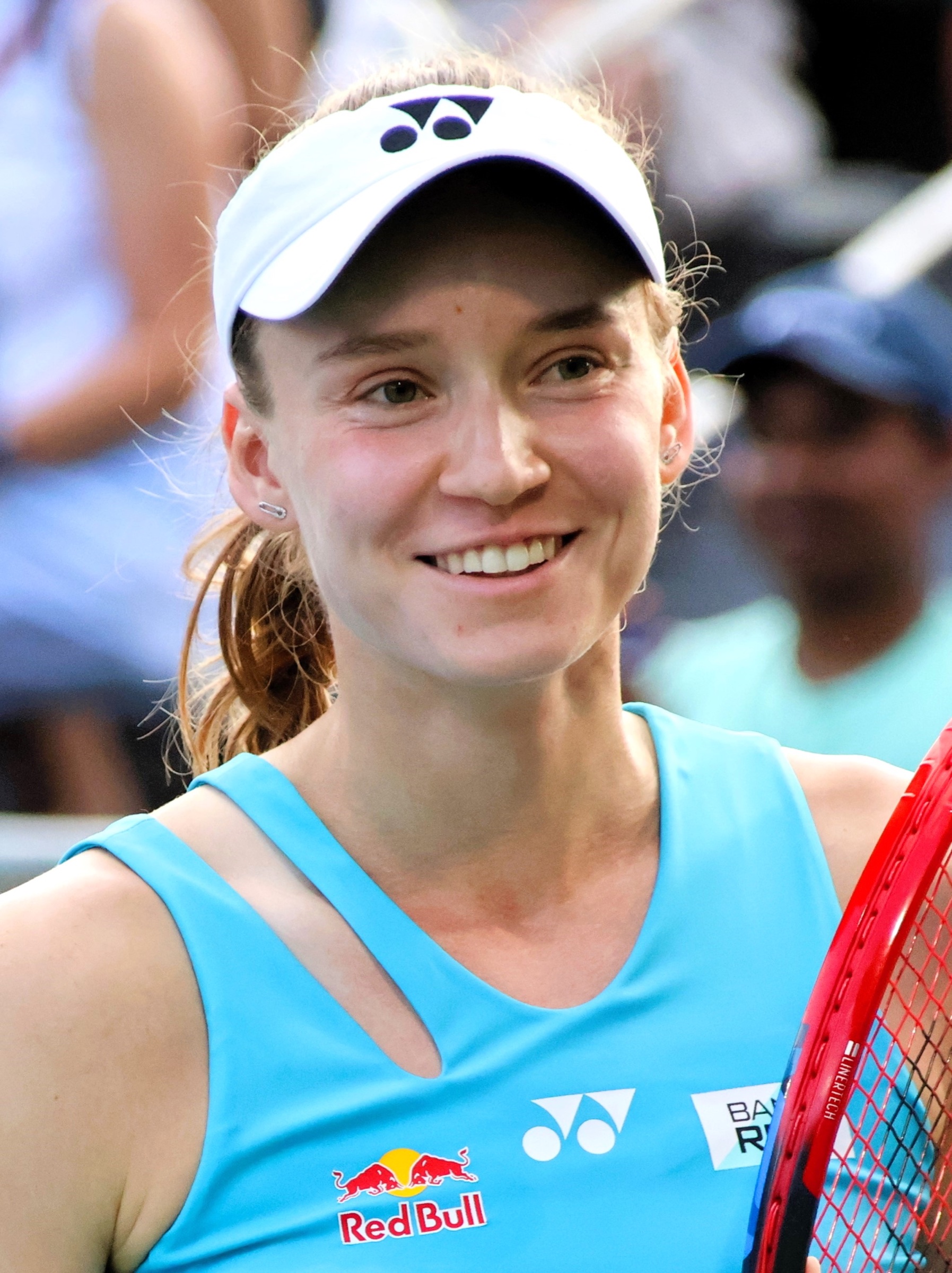
FigureAsia 35 Under 35 · Sports
Elena Rybakina
Age 26 · WTA singles · Kazakhstan
Season-ending champion who carried form into a major title
- Age at the edition eligibility date
- 26
- Field
- Tennis
- Country or region
- Kazakhstan
- FigureAsia U35 Assessment
- 98.0 / 100
Profile
Career and documented record
Elena Rybakina turned late qualification for the 2025 WTA Finals into an undefeated championship run, then carried the same competitive momentum into a major title. She reached Riyadh as the final qualifier and won all five matches, including victories over Iga Swiatek and world No. 1 Aryna Sabalenka. Her 6–3, 7–6 win over Sabalenka in the final completed an 11-match winning streak. It also closed a 58–19 season in which she won Strasbourg, Ningbo and the WTA Finals. Early in 2026, Rybakina added the Australian Open, her second major singles championship, and returned to world No. 2.
The Kazakhstani representative works across the international WTA Tour, where her current responsibility is entirely individual: manage service patterns, first-strike aggression and match adjustment across changing opponents, surfaces and tournament formats. Her assessed record spans an ordinary tour event, an elite round-robin championship and the extended knockout demands of a major. That breadth is what makes the run significant. A single strong week can decide a tennis title; Rybakina joined separate weeks into a sustained sequence and then proved that the form survived the off-season. For Kazakhstan and Central Asia, her results provide a current global reference at the top of women's professional tennis. Their importance, however, does not rest on representation alone. It rests on five wins from five in Riyadh, three titles during 2025 and the Australian Open trophy that followed.
FigureAsia selection
Why Elena Rybakina is on the list
FigureAsia selected Rybakina because the evidence connects year-end supremacy in 2025 with the most consequential opening title of 2026. The WTA Finals assembled the season's leading qualifiers, and she defeated every opponent placed before her, including Swiatek and Sabalenka. The Australian Open then converted that closing surge into a second major championship instead of leaving it as a brief late-season peak. Three 2025 titles, 58 match wins and an 11-match winning streak give the headline victories sufficient volume.
Her strongest marks lie in verified impact, level of competition and individual agency. Tennis exposes a player to shifting draws and conditions, but the range of events reduces dependence on one favourable route: Strasbourg, Ningbo, a round-robin final and a two-week major asked different competitive questions. Her overall 2025 record included 19 defeats, preventing the assessment from describing the season as comprehensive dominance. The 98.0 score nevertheless reflects a clear continuity across the reporting window. She entered the Finals last, left undefeated, and returned in 2026 to win a major and regain world No. 2. Those are completed results against elite senior opposition, not projections drawn from serve speed, ranking potential or previous reputation.
Verified work
The 2025–26 record
WTA Finals
Went 5-0 in Riyadh and defeated world No. 1 Aryna Sabalenka 6-3, 7-6 in the final.
Three-title season
Won Strasbourg, Ningbo and the WTA Finals, finishing 58-19.
Australian Open
Won her second major singles championship and returned to world No. 2.
Field context
The work in its field
Rybakina's most credible peers are the leading women's singles players she met in Riyadh and across the Australian Open draw. The WTA Finals offered a compact comparison because qualification restricted the field to the season's leading performers; a 5–0 record removed the ambiguity of one upset. The Australian Open then tested endurance and adjustment over a longer knockout format. Her 58–19 season was not flawless, but three titles establish repeatability across the calendar. The defining quality is continuity: the late-2025 run did not end with the season, but became a major championship in 2026.
FigureAsia U35 Assessment
Assessment breakdown
98.0out of 100
Substantive 2025-2026 contribution
20.0 / 20
Rybakina closed 2025 undefeated at the WTA Finals and carried that form into the 2026 Australian Open title.
Verified impact
15.0 / 15
A 5-0 Riyadh record, 58 match wins and three season titles provide measurable depth around the two headline championships.
Originality and distinction
9.0 / 10
Qualifying last and then defeating every Finals opponent, including Swiatek and Sabalenka, made the turnaround distinctive.
Industry influence
9.0 / 10
Her undefeated title against the season's leading qualifiers and return to world No. 2 altered the tour's competitive order.
Individual agency
10.0 / 10
Singles results, service performance and match decisions are wholly attributable to Rybakina rather than a collective programme.
Durability and demonstrated trajectory
5.0 / 5
An 11-match winning run crossed the season boundary and culminated in a second major, demonstrating sustained trajectory.
Asian significance and global relevance
5.0 / 5
Kazakhstan's leading women's player converted Central Asian representation into victories over the strongest global professional field.
Level of competition
10.0 / 10
The WTA Finals and Australian Open supplied elite round-robin and two-week knockout competition against top-ranked opponents.
Competitive result
8.0 / 8
Wins over world No. 1 Sabalenka in Riyadh and through the Australian Open draw produced two premier titles.
Cross-format consistency
4.0 / 4
Titles at Strasbourg, Ningbo, the Finals and Melbourne show effectiveness across tour tiers, conditions and tournament structures.
Sporting consequence
3.0 / 3
The Australian Open championship turned an exceptional late-2025 run into a major result and restored the world No. 2 ranking.