
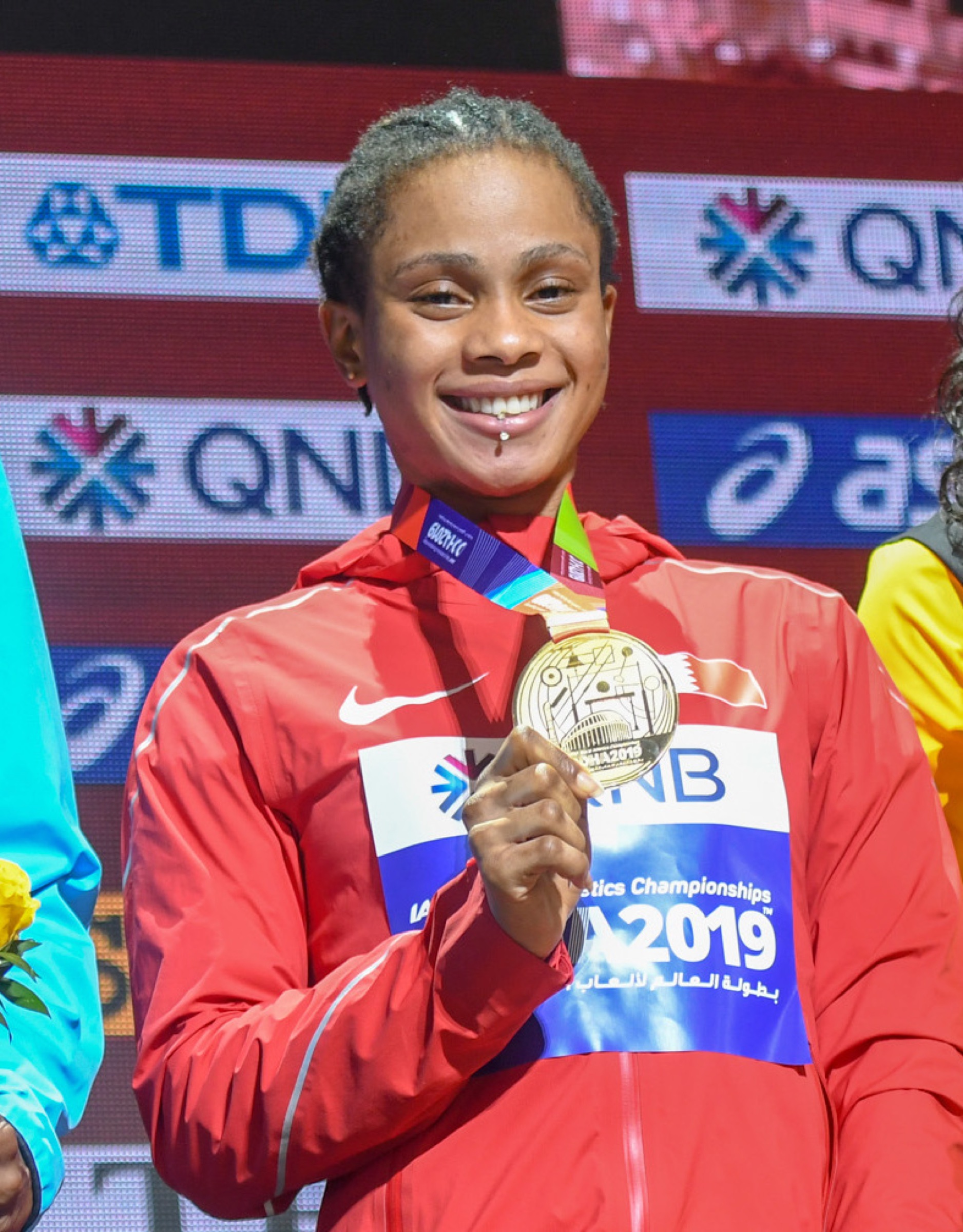
FigureAsia 35 Under 35 · Sports
Salwa Eid Naser
Age 27 · 400 metres · Bahrain
World bronze medallist in a 47-second championship final
- Age at the edition eligibility date
- 27
- Field
- Athletics
- Country or region
- Bahrain
- FigureAsia U35 Assessment
- 89.1 / 100
Profile
Career and documented record
Salwa Eid Naser's bronze medal at the 2025 World Championships contains more information than its colour first suggests. In Tokyo she ran 48.19 seconds, her fastest 400 metres since 2019 and the ninth-fastest performance recorded at the time. Sydney McLaughlin-Levrone and Marileidy Paulino finished ahead of her in the first women's 400-metre race to place two athletes below 48 seconds. Naser's mark would have won every previous edition of the championship except one. That comparison does not turn third place into victory; it establishes the quality of a final in which the event's standard moved sharply forward.
Naser represents Bahrain on the international athletics circuit. Her work is compressed into one lap but contains no shared competitive credit: pacing, position and speed are hers, with the clock supplying an independent record. The public account uses citizenship and sporting representation to establish her West Asian connection and does not infer identity from her Nigerian birthplace. Her 2025 contribution matters beyond a personal best because it asks readers to judge performance against the race actually run, not an abstract medal hierarchy. A 48.19 bronze in a 47-second championship final can carry stronger evidence than gold in a slower or less competitive field. The selection remains precise rather than expansive. It does not claim a season of multiple titles or place Naser above the two women who beat her. It recognises a world-final performance that entered the all-time list and demonstrated how far the women's 400 metres had advanced.
FigureAsia selection
Why Salwa Eid Naser is on the list
Salwa Eid Naser ran 48.19 seconds in the 2025 world final, a bronze-medal performance that entered the all-time top ten. Her strongest criteria are verified impact, level of competition and individual agency. The time of 48.19 seconds is independently measured, entirely attributable to her run and anchored to a final featuring two sub-48 performances. Ninth on the world all-time list at the time, it gave the bronze medal exceptional historical depth without altering the finishing order.
The editorial judgement distinguishes performance quality from title consequence. Naser did not win the race, and the profile does not treat an all-time mark as equivalent to a championship. The case is also concentrated in one principal event rather than a season of repeated victories. Those limitations are stated because the same clock that validates 48.19 also records that two competitors were faster. She was selected because the final brought the world's strongest direct comparison and her result would have won almost every earlier edition of the championships. The Bahraini connection establishes geographic eligibility but adds no competitive credit. Selection rests on a precisely timed senior performance, the exceptional field in which it occurred and a bronze whose measured quality cannot be understood through podium order alone.
Verified work
The 2025–26 record
World final
Ran 48.19 seconds to win the 400-metre bronze medal.
All-time position
Moved to ninth on the world all-time 400-metre list.
Championship context
Competed in the first women's 400-metre final with two athletes below 48 seconds.
Field context
The work in its field
Championship medals usually provide an immediate hierarchy, but the 2025 women's 400-metre final demands a second reading through the clock. McLaughlin-Levrone and Paulino ran below 48 seconds, making Naser's 48.19 both third place and the ninth-fastest performance in history at the time. That time would have won all but one previous championship edition, yet it did not win this one. The comparison therefore rewards competition quality without revising the result. The resulting case combines limited title consequence and a narrow sample with unusually strong global calibration. Timing makes both the distinction and its limit visible.
FigureAsia U35 Assessment
Assessment breakdown
89.1out of 100
Substantive 2025-2026 contribution
16.0 / 20
Naser ran 48.19 seconds in the 2025 World Championship 400-metre final and won bronze.
Verified impact
13.5 / 15
Fully automatic timing placed her ninth on the world all-time list despite two faster women in the same race.
Originality and distinction
10.0 / 10
Running a time that would have won nearly every earlier championship while finishing third made the performance exceptional.
Industry influence
8.0 / 10
The 48.19 mark set a new contemporary reference for elite 400-metre depth beyond the two sub-48 finalists.
Individual agency
10.0 / 10
The recorded time and lane performance are solely Naser's, with no relay or team attribution.
Durability and demonstrated trajectory
4.0 / 5
A world-final peak confirms return to elite form, though the published case contains limited breadth across separate meetings.
Asian significance and global relevance
5.0 / 5
Representing Bahrain, Naser delivered a West Asian medal within one of athletics' most globally competitive finals.
Level of competition
10.0 / 10
McLaughlin-Levrone and Paulino both broke 48 seconds, making this the fastest women's 400-metre championship race assembled.
Competitive result
6.4 / 8
Bronze is a clear global medal but remains third place, irrespective of the historically fast clocking.
Cross-format consistency
3.2 / 4
Her record is confined to the individual 400 metres rather than multiple distances or a relay campaign.
Sporting consequence
3.0 / 3
Her 48.19 entered the all-time top ten and secured a world medal without producing the championship title.