
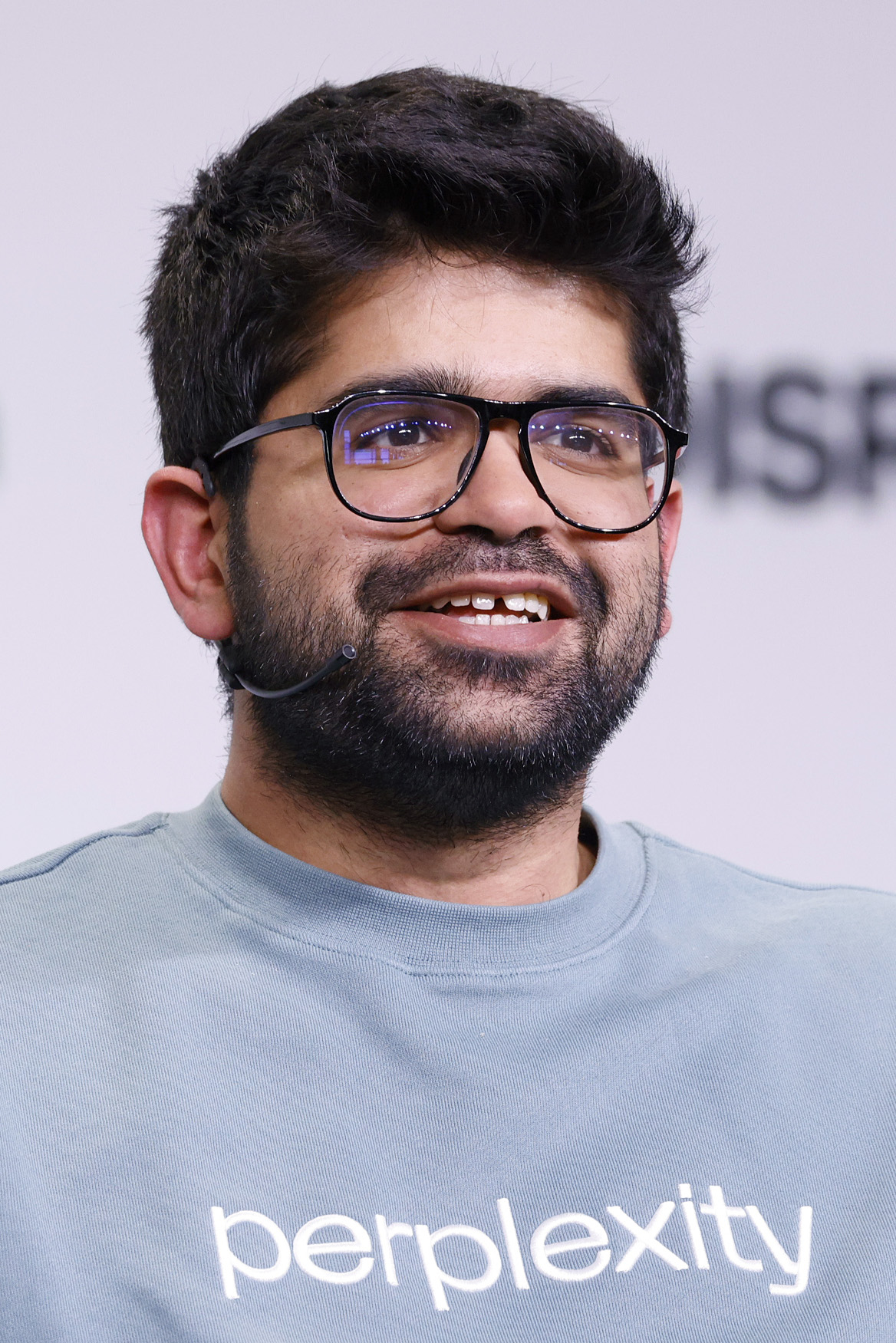
FigureAsia 35 Under 35 · AI
Aravind Srinivas
Age 31 · Researcher-founder · India and United States; globally accessible search and browsing products
Recasting Search as a Conversational Answering System
- Age at the edition eligibility date
- 31
- Field
- Retrieval-grounded search, answer systems and browsing agents
- Country or region
- India and United States; globally accessible search and browsing products
- FigureAsia U35 Assessment
- 89.9 / 100
Profile
Career and documented record
Aravind Srinivas has made retrieval, citation and conversational synthesis central to a new model of internet search. Expansion into search-optimised models and an agentic browser in 2025 demonstrated both the appeal of that proposition and the unresolved obligations it creates toward publishers.
Aravind Srinivas grew up in Chennai, studied at the Indian Institute of Technology Madras and completed doctoral work at the University of California, Berkeley. After research roles at several AI laboratories, he co-founded Perplexity in 2022 and became its chief executive. The company’s central product reframes search as an iterative conversation: it retrieves material from the web, synthesises an answer and presents supporting links. That interface has influenced the wider search market, making citation-bearing answers a mainstream expectation. It has also exposed a difficult editorial question. Publishers and news organisations have accused the company of reproducing protected material, bypassing controls or presenting inaccurate citations. The company has disputed aspects of those claims and introduced publisher programmes, but the controversy remains material to any assessment of its impact. In February 2025, it released Sonar, an in-house model optimised for search. The company reported high inference speed and favourable user comparisons; these were internal evaluations. In July it introduced Comet, a browser designed to carry conversational search and agents into tasks performed across the web. Srinivas’s significance lies in establishing a credible alternative interaction model for information discovery. Its lasting authority will depend on whether speed and convenience can be reconciled with attribution, accuracy and the economics of original reporting.
FigureAsia selection
Why Aravind Srinivas is on the list
FigureAsia selected Srinivas because he has influenced how users, platforms and incumbents imagine the search interface. Perplexity brought answer synthesis, follow-up questioning and linked support into a coherent product used at meaningful scale. That influence is inseparable from accountability. Search systems operate on knowledge created by others, and publisher disputes over crawling, reproduction and citation accuracy are central—not peripheral—to judging the work. FigureAsia recognises the category-defining contribution while treating source integrity and sustainable relationships with original publishers as unfinished tests.
Verified work
The 2025–26 record
Verified contribution 01
In February 2025, the company introduced Sonar, its search-optimised in-house model, publishing speed and preference results as company evaluations.
Verified contribution 02
In July 2025, it launched Comet, an agentic browser designed to extend conversational search into multi-step web activity.
Verified contribution 03
During 2025, Srinivas continued publicly articulating retrieval-grounded answers as an alternative to conventional ranked-link search.
Field context
The work in its field
The product is globally accessible across languages and jurisdictions. The company has reported substantial query and user growth, but complete audited regional usage and retention figures are not available publicly.
Srinivas is an India-born researcher whose path from Chennai to Berkeley and Silicon Valley illustrates Asia’s growing influence on the design of globally used information systems.
FigureAsia U35 Assessment
Assessment breakdown
89.9out of 100
Defining contribution
23 / 25
A completed piece of work, institution or system that materially changes what the field can do.
Demonstrated impact and reach
18.4 / 20
Observable adoption, scientific use, policy consequence or operational reach, with self-reported metrics labelled as such.
Personal agency and attribution
13.8 / 15
Evidence that the individual shaped the result, separated from team, employer and investor halo.
Technical or institutional originality
13.65 / 15
A new method, product form, research direction, governance mechanism or deployment model.
Durability and field-shaping influence
8.9 / 10
The likelihood that the contribution will remain useful beyond a single news cycle or model release.
Evidence integrity and responsible practice
7.4 / 10
The quality of the record, the precision of claims and the seriousness with which limitations and harms are addressed.
Asia–world relevance
4.75 / 5
A documented connection to Asia, impact on Asian systems, or clear importance to the region’s place in the international field.