
FigureAsia 35 Under 35 · AI
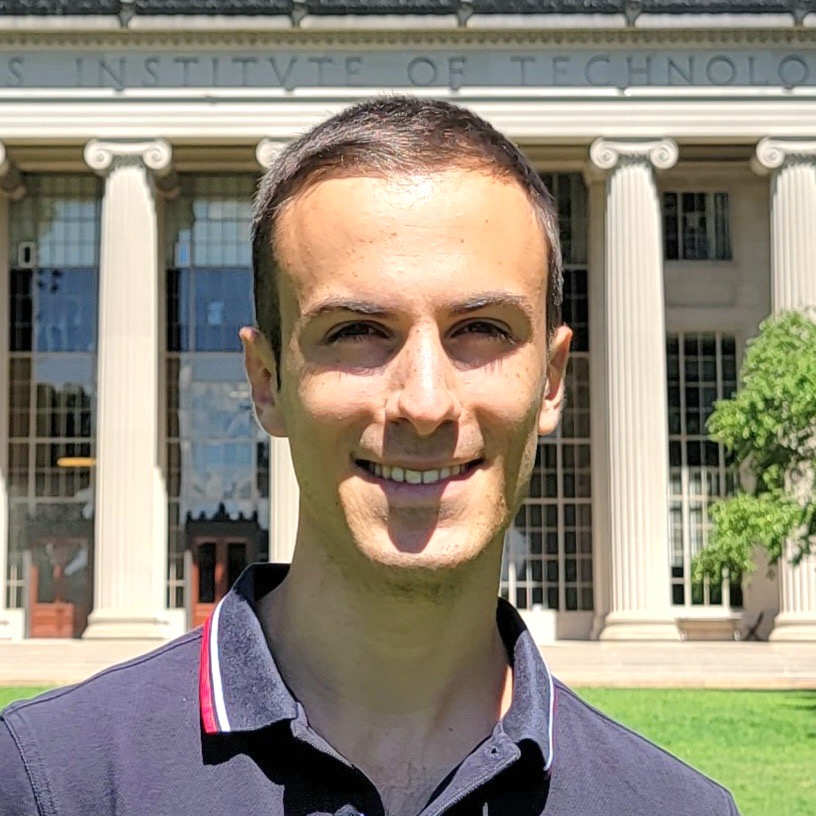
Gabriele Corso
Age 26 · Researcher-founder · Italy, United Kingdom and United States; open biomolecular models available internationally
Keeping the Molecular Artificial Intelligence Frontier Open
- Age at the edition eligibility date
- 26
- Field
- Open biomolecular modelling and AI for drug discovery
- Country or region
- Italy, United Kingdom and United States; open biomolecular models available internationally
- FigureAsia U35 Assessment
- 91.1 / 100
Profile
Career and documented record
Gabriele Corso is turning biomolecular AI from a guarded capability into shared scientific infrastructure—without mistaking benchmark promise for a finished drug. His work combines model research, permissive release and institution-building around a field whose claims demand unusually careful validation.
Drug discovery is often described as a race for better models. Gabriele Corso has made it a contest over who gets to use them. An Italian computer scientist trained at Cambridge and MIT, he helped lead the Boltz family of open biomolecular models and now runs a public-benefit company built around open research. His defining 2025 contribution, Boltz-2, brings together two problems often treated apart: predicting how biomolecules arrange themselves and estimating how strongly they bind. The project reported performance approaching free-energy perturbation on selected affinity benchmarks, with substantially lower computational requirements, and released model weights, inference code and training code under a permissive licence. That made an advanced molecular-modelling system inspectable and adaptable beyond a small circle of well-capitalised laboratories. The openness matters as much as the benchmark. Drug discovery is cumulative: models improve when scientists can test difficult targets, expose failure modes and build upon one another’s work. Corso treats access not as a communications gesture but as part of the scientific method. The ambition is considerable, but so is the need for restraint. Boltz-2’s comparative accuracy remains under active scrutiny, and computational promise is not a therapy. What is already clear is Corso’s unusual ability to move between mathematical research, usable scientific infrastructure and institution-building while keeping the frontier open to examination.
FigureAsia selection
Why Gabriele Corso is on the list
FigureAsia selected Corso because he combines frontier technical work with an unusually consequential position on access. The judgement does not rest on one benchmark score, but on his role in making an advanced scientific capability available for independent testing, adaptation and commercial use. He also demonstrates the ability to carry research into maintained infrastructure without closing the underlying work. The selection remains deliberately cautious about comparative accuracy: openness is established, scientific utility is plausible, and therapeutic consequence is not yet proven.
Verified work
The 2025–26 record
Verified contribution 01
Served as a core contributor and research lead on Boltz-2, which integrates biomolecular structure prediction with estimates of protein–ligand binding affinity.
Verified contribution 02
Helped release model weights, inference code and training code under a permissive open licence; the paper reports at least 1,000-fold greater computational efficiency than free-energy perturbation on its selected comparisons.
Verified contribution 03
Moved from academic model development into institution-building as co-founder and chief executive of a public-benefit company organised around open biomolecular research.
Field context
The work in its field
The permissively licensed release gives academic and industrial teams worldwide a common, inspectable foundation for biomolecular modelling. Its international significance lies in distribution as much as performance: laboratories do not need a privileged institutional relationship to examine or extend the system.
For Asian universities, biotechnology companies and public laboratories that cannot depend on restricted proprietary systems, an inspectable and commercially usable model can lower the cost of participating in advanced computational drug discovery. No Asia-specific adoption claim is made.
FigureAsia U35 Assessment
Assessment breakdown
91.1out of 100
Defining contribution
23.25 / 25
A completed piece of work, institution or system that materially changes what the field can do.
Demonstrated impact and reach
17.4 / 20
Observable adoption, scientific use, policy consequence or operational reach, with self-reported metrics labelled as such.
Personal agency and attribution
13.95 / 15
Evidence that the individual shaped the result, separated from team, employer and investor halo.
Technical or institutional originality
14.25 / 15
A new method, product form, research direction, governance mechanism or deployment model.
Durability and field-shaping influence
9.1 / 10
The likelihood that the contribution will remain useful beyond a single news cycle or model release.
Evidence integrity and responsible practice
8.6 / 10
The quality of the record, the precision of claims and the seriousness with which limitations and harms are addressed.
Asia–world relevance
4.55 / 5
A documented connection to Asia, impact on Asian systems, or clear importance to the region’s place in the international field.