
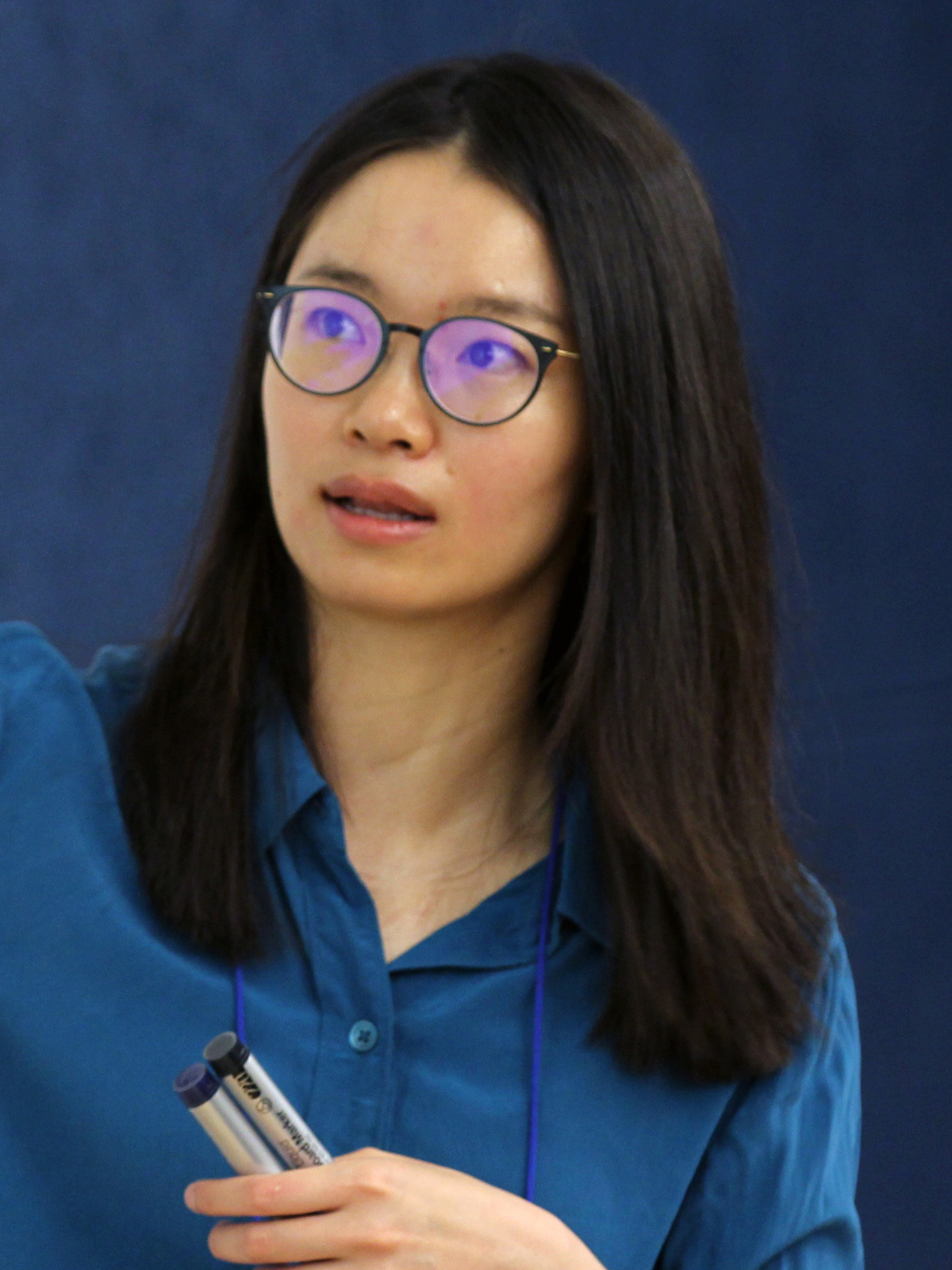
FigureAsia 35 Under 35 · Science
Hong Wang
Age 34 · Harmonic analysis and geometric measure theory · China / France / United States
Co-author of the 2025 proof that three-dimensional Kakeya sets have full dimension.
- Approximate age at the edition eligibility date
- 34
- Field
- Mathematics
- Country or region
- China / France / United States
- FigureAsia U35 Assessment
- 97.4 / 100
Profile
Career and documented record
In February 2025, Hong Wang and Joshua Zahl posted a 125-page proof of the three-dimensional Kakeya conjecture. Their result establishes that a set in three-dimensional space containing a unit line segment in every direction must have full Hausdorff and Minkowski dimension—settling the central geometric statement in the first unresolved dimension.
The proof is the product of years of work on polynomial partitioning, incidence geometry and the geometry of tubes. It matters beyond one celebrated conjecture: Kakeya estimates sit deep inside harmonic analysis and influence the study of oscillatory integrals, wave propagation and partial differential equations.
Wang entered the period as one of the field's most formidable young analysts and emerged with a result that changed its map. Credit is shared precisely with Zahl; the distinction lies in a joint achievement whose difficulty and consequence are already recognised across mathematics.
FigureAsia selection
Why Hong Wang is on the list
Few under-35 scientific records can be stated so cleanly. Wang helped resolve a decades-old problem at the centre of analysis, with a complete proof open to line-by-line scrutiny and consequences that reach far outside the theorem's original formulation. That combination of depth, finality and field-wide importance defines her selection.
Verified work
The 2025–26 record
Three-dimensional Kakeya conjecture
With Joshua Zahl, proved full Hausdorff and Minkowski dimension for Kakeya sets in R³.
Open technical record
Published the full 125-page argument as an openly available preprint for specialist scrutiny.
Field recognition
The result was cited in major mathematical awards and institutional appointments during the period.
Field context
The work in its field
The Kakeya problem is a benchmark for how geometry controls concentration. A full-dimensional result in three dimensions removes the first major obstruction and gives analysts a new foundation for adjacent estimates.
FigureAsia U35 Assessment
Assessment breakdown
97.4out of 100
Substantive 2025–2026 contribution
19.3 / 20
With Joshua Zahl, proved full Hausdorff and Minkowski dimension for Kakeya sets in R³.
Verified scientific impact
14.6 / 15
The theorem resolves a major open problem and was rapidly recognised by leading mathematical institutions.
Originality and distinction
9.7 / 10
The distinction lies in a new joint proof architecture capable of controlling the multiscale geometry of Kakeya sets.
Field influence
9.7 / 10
For Wang, field influence turns on whether this work changes the operating baseline in harmonic analysis and geometric measure theory; the record supports that judgement.
Individual agency
9.8 / 10
Wang is an equal co-author of the proof; the profile does not assign Joshua Zahl's contribution to her.
Durability and trajectory
4.9 / 5
A continuing programme at IHES and NYU Courant Institute extends beyond this single result.
Asian significance and global relevance
4.9 / 5
Born in Guilin, China, educated at Peking University and active across the Chinese mathematical diaspora.
Evidential validity and reproducibility
7.8 / 8
The complete argument is public and has been exposed to sustained specialist checking rather than announced only as a result.
Advance in scientific knowledge
6.9 / 7
The work settles the three-dimensional case and changes the baseline from which harmonic analysts approach related restriction problems.
Translational or methodological utility
4.9 / 5
Its value is primarily foundational: the proof supplies tools and structural insight for later work across analysis and PDE.
Responsible research stewardship
4.9 / 5
Authorship is stated jointly and the assessment keeps the distinction between a posted proof, community scrutiny and later corollaries.